
From local waste systems to a circular Europe: what should the EU Circular Economy Act deliver?
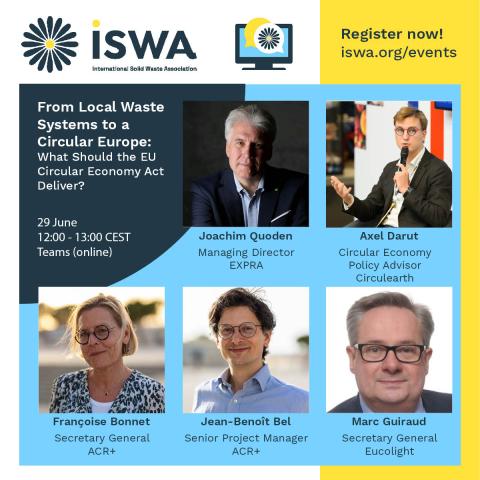
The European Commission is preparing a new Circular Economy Act (2026) to boost the market for secondary raw materials and strengthen Europe’s competitiveness and resilience.
But a key question remains: Can a circular economy work without strong local waste systems?
Secondary materials depend on effective collection, sorting, treatment and public participation. Municipal waste management is therefore a key starting point of the circular economy.
The EU Group of the International Solid Waste Association (ISWA) is organising a webinar to explore how the Act can move from targets to implementation, focusing on the role of local systems, policies and producer responsibility schemes.
It will look at:
- How can the Circular Economy Act support stronger municipal waste management systems?
- Where is EU harmonisation needed, and where must local flexibility remain?
- How can Europe improve the quality and reliability of secondary raw materials?
- How can collection, sorting, treatment and recycling systems be financed fairly and effectively?
- How can producer responsibility schemes support local waste systems without becoming the only answer to all circular economy challenges?
- How can the Act address free-riding, online sales and weak enforcement?
- How can the Circular Economy Act avoid becoming another layer of obligations and instead become a tool for practical implementation?
The discussion will bring together ACR+, Circulearth and EucoLight, offering complementary perspectives from across the circular economy. It will argue that there is no circular single market without strong local waste systems, and the Circular Economy Act also needs to strengthen local waste-management and producer-responsibility systems that make secondary raw materials available, clean, traceable and usable.
This webinar will take place at 12:00-13:00 CEST on 29 June. Registration.