
EU-ATLAS on Circularity in Airports
EU-ATLAS on Circularity in Airports
Organisation or company
Document type
Recipient profiles
Country
EU
Language for original content
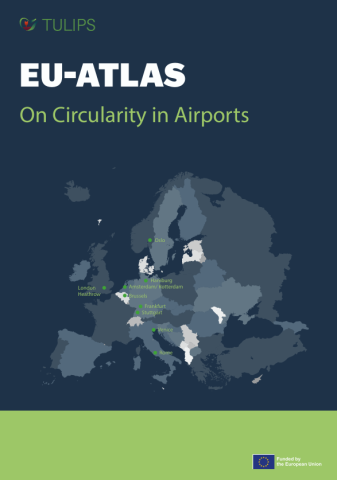
Airports are complex ecosystems with significant influence over infrastructure, operations and regulation, making them well‑positioned to advance circular transformation. In the Atlas, ten European airports share practical use cases to support knowledge transfer and harmonise circularity measurement.
The Atlas highlights key trends, regulations and priorities shaping circular economy progress in EU airports, and outlines options for monitoring impact. Drawing on the use cases, it summarises lessons learned and identifies expected future developments in circular airport operations.
It finds that European airports are steadily embedding circular economy principles into their operational and strategic agendas.
They apply circular economy principles across four main strategic domains: Terminals, Offces, Airlines and Construction. These domains are interconnected: decisions made in one domain—such as procurement standards in construction or concession requirements in terminals—directly influence material flows, waste generation and reuse potential elsewhere in the airport ecosystem.
Interviews with 10 major airports highlighted the diversity of approaches to circularity. Despite diverging contexts, four common focus areas emerged: waste management, tenant collaboration, cabin waste, and construction. This confirms that circular efforts are emerging first where material volumes, visibility and airport influence are highest.
See also Circular construction at airports - Delivering circular construction in airport infrastructure