
STILLMETALEVO: Turning steel and foundry waste into critical raw materials
European industries urgently need to secure Critical Raw Materials (such as metallic silicon, magnesium, aluminum and manganese) while simultaneously drastically reducing carbon emissions and landfill disposal. In the Veneto region alone, foundries and steel industries generate millions of tons of inorganic waste annually.
Building on a 2022 feasibility initiative co-funded by EIT RawMaterials, STILLMETALEVO demonstrates that targeted industrial processing can transform environmental waste liabilities into economic assets.
Its two energy-efficient recovery processes are designed to operate individually or sequentially:
- High-Efficiency Thermomechanical Processing: processes spent foundry sands alongside fine dust from exhaust systems without generating secondary waste. By utilising residual carbon coke present in the waste as a secondary fuel, the plant achieves significant thermal energy recovery (up to 300 kW/ton). Outputs include high-purity regenerated silica sand (reused in foundry molding cores) and calcined clay powder used as a pozzolanic binder in low-carbon cements.
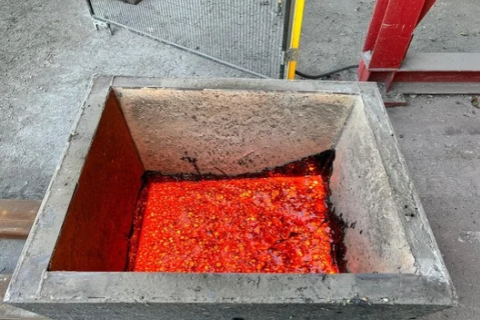
- Exothermic Aluminothermic Processing: treats Electric Arc Furnace and Secondary Metallurgy steel slags at high temperatures (1400°C–1700°C) via an exothermic oxidation-reduction reaction with scrap aluminum. In the newly engineered OXITERM 10 rotary furnace reactor, the process achieves energy reduction of up to 90% compared to traditional smelting. It separates the molten mass into two valuable outputs: a high-purity ferrosilicon alloy for local steelmaking and calcium-aluminate reactive minerals.
This R&D project is funded under the EU Cohesion Policy 2021–2027 of the Veneto Region.
By September 2026, industrial end-users successfully formulated and prototyped groundbreaking circular products from these recovered intermediates, including:
- interlocking paving stones and bio-construction insulation blocks made by mineralizing natural rice husk fibers with recycled inorganic binders, achieving 100% recycled content.
- porous mineral foam monoliths and granules for wastewater decontamination, achieving 80% to 100% capture efficiency for heavy metals (copper, iron, nickel, manganese) and addressing emerging pollutants like PFAS and arsenic.
- low-carbon LC3 cement matrices for structural precast concrete panels and non-structural photovoltaic ballasts.
- adsorbent granules for heavy metal soil inertization and stabilization.