
CHARPLAST: challenges for and advances in plastic material characterisation
Date
31 Oct 2025
News type
Scope
Key Area
Country
Spain
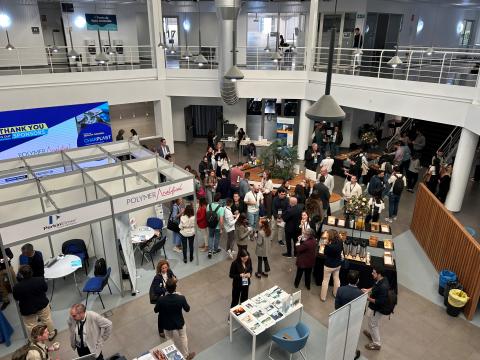
The International Seminar on Plastic Characterisation took place on 29 and 30 October, hosted by AIMPLAS, the Plastics Technology Centre. About a hundred international specialists discussed the latest analytical techniques applied to plastic characterisation, environmental degradation and the challenges of the circular economy.
What did they talk about?
Session on Advanced characterisation techniques:
- The main challenges in studying plastic degradation are the lack of standardised methods that make comparisons between laboratories unreliable, the complexity of characterising nanoplastics below one micron and the scarcity of toxicological data. The proposed solutions included moving towards multidisciplinary approaches, combining techniques and leveraging AI to improve analysis.
- Evolved gas analysis and pyrolysis-GC/MS can be used to deformulate plastic bags. These techniques provide details on the composition of conventional, bio-based, biodegradable and recycled plastics.
- Temperature modulation in thermogravimetric studies optimises the acquisition of data on activation energy and material lifespan, reducing time and number of analyses.
Session on Characterisation in the context of sustainability:
- Hydrogen affects polymers, and research into the mechanical properties of materials is essential to ensure safe hydrogen transport and storage.
- Closed loops have to be established in the automotive sector, using components designed for dismantling and recycling.
Session on Monitoring and mitigation of emerging contaminants:
- This session touched on innovative strategies to extract emerging contaminants from complex matrices, the use of MicroFTIR for routine analysis and monitoring of contaminants in wastewater in Valencia, and alternative methodological approaches for assessing environmental and human risks.
Session on Predictive models, simulation and AI in the world of characterisation:
- Predicting plastic material properties with Machine Learning models requires a large amount of data, and this data needs to be of a high standard to develop robust models with high predictive accuracy.
- Applications for waste detection and separation, using innovative algorithms that employ different image spectra to optimise and adapt solutions to sector challenges.
- The outcome of the CARACT4BIO project, which aimed to provide companies with tools to improve the design and production of bioplastics by optimising formulations to balance technical performance and environmental impact.
- The capabilities of new QSAR models for property prediction, with plastic additives that help companies comply with legislation such as REACH.
Session on Success stories in quality control applied in industry:
- SYMBIOREM, a project applying circular bioremediation and biotechnology to achieve sustainable decontamination.
- Characterisation studies have solved complex problems in industrial environments, demonstrating the value of advanced analytics.
- Thermal analysis is used to monitor the impact of mechanical recycling on thermoplastics, providing key data to optimise processes and extend material lifespan.
- This block showed how applied science and collaboration between industry and technology centres are essential to move towards more efficient, safe and sustainable production.