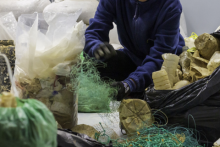
This study explores how social ties and social impact can be accounted for in circular economy initiatives.
It examines how a local project managing organic waste and unsold goods fosters social ties in a priority urban neighborhood in France, and how these dynamics can be grasped using an alternative qualitative accounting approach.
It identifies key creators of social ties within local initiatives, proposes a social balance sheet highlighting factors that stimulate or undermine these ties and introduces a methodological approach for counting or recounting social impact in circular economy projects.
The FertiCovery project focuses on nutrient recovery and the production of fertilisers from biowaste, manure and wastewater.
This workshop will look at the upscaling potential of the 25 technologies assessed by the project and examine the regulatory frameworks governing them, including barriers and enablers.
The SUINK project aims to design and implement sustainable, flexible and printable self-charging power systems to supply power to a wide range of sensors for the automotive industry.
This webinar will present their printed, recyclable piezoelectric harvesting system designed to harvest electrical energy from mechanical vibrations, a printed bio-based supercapacitor for energy storage and the SUINK self-charging power system.
The PROMOFER project aims to produce circular biobased products for use in the agriculture, packaging and textiles sectors from low value, renewable feedstocks (specifically starches, whey permeate, industrial wastewater, rice straw, wheat straw and prune waste). They've just taken stock of progress to date!
Find out about a new EU-funded project! MARMADE aims to use crustacean residues and seaweed as the raw material to produce sustainable, high-value food and feed ingredients.
This conference will tackle climate change and ways to prevent it, including innovative solutions that can be implemented under the Green Deal Strategies.
They're calling for abstracts: the deadline is 1 September!
Brazil’s mining sector has underpinned national growth and is a major global supplier of iron ore, bauxite, niobium and copper. However, the linear model is producing declining ore grades, rising waste volumes and growing environmental and social pressures.
To remain competitive, Brazil must shift to a circular model. Strategies such as reprocessing tailings, recovering by-products, designing for reuse and establishing closed-loop partnerships can unlock significant economic and environmental value.
This report looks at circular solutions being implemented in the mining sector and how designing urban renewable energy systems for reuse will turn cities into urban mines.
Every year, the Valencian agricultural sector generates around 800 000 tons of plant waste, such as rice straw and citrus pruning waste. Unfortunately, the methods used to recover this biomass are costly. The EU-funded BIOVALSA project aims to develop innovative processes for manufacturing sustainable bioplastics from these waste streams.
The EU strategy for sustainable and circular textiles calls for policy interventions to reduce waste and overconsumption in this sector. However, future policies may have unintended impacts.
This study examines the unintended effects of past and future textile policies, with the goal of evaluating scientific tools for improving ex ante impact assessments and so mitigating unintended effects in future.
It finds that the unintended impact of a policy can be just as important as the impact that it was designed to achieve. Stakeholder engagement, combined micro- and macro-economic modelling, extended consideration of the EU's resilience and the inclusion of a behavioural and social component are all key to reducing unintended impacts.
The webinar will explore how advanced materials and circular design approaches are shaping the future of high-performance composite applications, with a focus on wind energy.