The transition to a circular economy is reshaping Europe’s industrial landscape, yet the role of machinery manufacturing remains underexplored.
As a key enabler of durability, remanufacturing and resource efficiency across value chains, the sector has significant potential to strengthen Europe’s competitiveness and resilience.
This workshop brought together modelling insights, industrial experience and policy perspectives to better understand this role.
Cities and regions across Europe are facing similar challenges - at different stages and in different contexts - when implementing the circular transition. Over the past year, CCRI communities of practice have brought practitioners together to openly share what works, what doesn’t, and where they get stuck.
This CCRI online workshop series builds directly on these insights, turning peer exchange into practical, hands-on sessions designed to help you move from ambition to concrete actions - no matter where you are in your transition.
Businesses are key drivers of regional transformation. Support from public authorities and cooperation with research institutions, local administrations and networks is key to overcoming barriers and unlocking the potential of the circular economy.
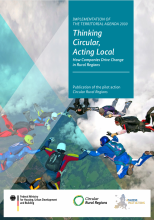
This publication shows how companies in rural regions can drive the transition towards a circular economy. Drawing on examples from German and European model regions, it highlights how local enterprises implement circular business models, what opportunities arise for regional value creation and resilience, and which policy and governance frameworks can foster this transformation.
The findings show that the circular economy is not only an ecological necessity but also a strategic pathway towards sustainable and resilient regional development.
This event will bring together experts, policymakers, researchers and practitioners to discuss how innovation, governance and finance can accelerate the transition toward a circular economy.
The RevHydro project aims to accelerate the integration of circular economy principles into hydropower plant operations and design an innovative fish barrier and guidance system.
The CEI BOOST project is linking up digitalisation and the circular economy in order to enable circular business models and accelerate the transition towards a sustainable circular economy. It focuses on specific policy instruments in nine countries and aims to improve them.
the call for evidence focuses too much on measures to enhance collection and recycling and too little on prevention, repair and reuse;
tackling consumption rates and increasing reuse will also reduce the EU’s reliance on imports;
welcomes the move to develop EPR schemes but feels that the non-profit sector and other key stakeholders involved in the design and implementation process should be involved as well as producers;
more effective circularity metrics and targets are needed, including separate targets for consumption reduction, repair, reuse and preparation for reuse;
dedicated and sufficient financial mechanisms and funding streams are needed to ensure the viability of prevention, repair and reuse initiatives across the EU.
The Government of Chile and the European Union invite Chilean and EU companies to submit detailed proposals describing innovative solutions to build or strengthen a sustainable and circular value chain that can contribute to Chile's environmental, social and economic development. The focus is on textiles, organic materials, photovoltaic panels and plastics.
On 3 December, the European Commission adopted the RESourceEU Action Plan to accelerate and amplify its efforts to secure the EU's supply of critical raw materials. The plan aims to reduce strategic dependencies and contains a number of measures relevant to the circular economy.