The WCYCLE Maribor project provides for an innovative urban circular economy system, offering a new business and economic model for the city in the field of efficient resource management.
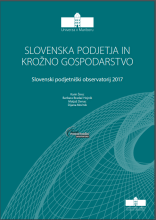
Since 2000, the “Slovenian Entrepreneurship Observatory” publishes a report annually providing analysis of the situation of Slovenian companies and insight into Slovenian entrepreneurship. In 2018 this report had a thematic focus on the circular economy (CE), with the authors centring in on the drivers and barriers to SMEs integrating CE into business practice.
This report first provides a theoretical framework for the CE, which aims to raise awareness and facilitate information exchange between companies and individuals looking to spread circular innovation. Simultaneously this report also provides an overview of the barriers companies face in transitioning towards circularity, which include a lack of comparable indicators to benchmark and track progress as well as cost of eco-design.
The underlying idea of the Strategy for the Transition to the Circular Economy (CE) in the Municipality of Maribor, as well as the Wcycle project, is to have an own innovative model as a system for managing all resources available in Maribor and the wider urban area.
The model is based on the operation of enterprises that are predominantly publicly-owned and already provide public services for residents. They are the city’s bottlenecks that until now have not functioned as a connecting link, which is a fundamental principle in the circular transition.
Only close cooperation between public companies, citizens, industry and local self-government can lead to a successful interconnected system that optimises resources and results - economic, environmental and social.
Ljubljana is faced with significant overgrowth of Japanese knotweed, a plant on the list of 100 most invasive non-native species worldwide. Ljubljana teamed up with the Re-generacija collective of young designers and architects focusing on issues connected to social and environmental well-being, as well as some other stakeholders, to prevent excessive overgrowth of the plant and reuse it.