This Policy Dialogue will take place on 7 June starting at 14:00 CEST. It will consider the importance of strategic resources, notably critical raw materials, for achieving the European Green Deal objectives, and the role for a circular economy in enabling access to those resources.
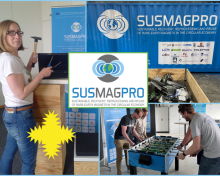
In the frame of the Leiden European City of Science Festival, the H2020 project SUSMAGPRO will be showcased in an interactive exhibition on campus at the Institute of Environmental Sciences (CML) on 7 June 2022. Interested visitors can learn all about rare earth magnets, why they are essential to our modern lives, the challenges connected to them and which solutions SUSMAGPRO provides.
In addition to an interactive exhibition and hands-on activities, the team of project partner Leiden University have prepared exciting lectures on the topic and visitors will have the opportunity to see one of the SUSMAGPRO pilots in action: the automated, mobile sensing line to separate Rare Earth magnets from WEEE.
Learn on Friday 3 June how the Level(s) tools can help you implement core indicators to assess and report on the sustainability performance of buildings.
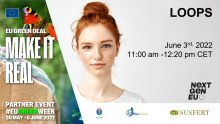
As the Horizon 2020 research programme becomes Horizon Europe, what better time to see how great ideas turned into real projects? LOOPS will be the opportunity to show what cutting-edge research has been produced, and what changes it can bring to our communities.
For those who are not familiar with it, LOOPS is a live webinar series committed to spotlighting innovation in the circular economy. The topic of the episode on 3 June will be the EU Soil Strategy.
Fecc, which represents the chemical distribution industry in Europe, is organising a multi-stakeholder panel discussion. The discussion will bring together members of the chemical distribution sector to discuss their sustainability initiatives and how they can be aligned with the current European regulatory framework on the circular economy and COVID-19 recovery.
The Circular Cities and Regions Initiative (CCRI) will be holding an EU Green Week 2022 partner event onWednesday 1 June at 15:00 - 16:00 CEST.
During the session, the CCRI-CSO will present the initiative to local authorities, decision makers, civil society and industry representatives. In addition, there will be contributions from the CCRI Associated Partners who are crucial in supporting cities in this transition. These organisations have and generate relevant knowledge regarding the application of Circular Systemic Solutions, making them vital when it comes to reaching out and bringing together cities and regions.
As part of the One Planet Network Forum at Stockholm+50, this 1 June session will present the roadmap idea and a panel discussion will discuss how a process could take shape. It will build on views from One Planet Network Forum participants to expand on the diverse stakeholder views included in Chatham House’s Stockholm+50 preparatory process to determine the next steps.
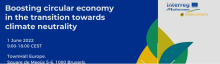
The Interreg MED Green Growth Community will celebrate its final event in person in Brussels on 1 June. The event will highlight the role of businesses and public authorities in the transition towards climate neutrality, sharing the project’s best practices in supporting these actors across the Euro-Mediterranean region.
The final event will also emphasise the importance of cooperation to boost the circular economy by putting forward the Community’s policy recommendations.
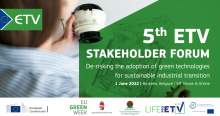
EU ETV (Environmental Technology Verification) is a circular economy tool that provides third-party verification of the performance of innovative technologies to help them enter the market. The EU ETV Secretariat invites you to attend the 5th ETV Stakeholder Forum: De-risking the adoption of green technologies for a sustainable industrial transition. The hybrid event will be held on 1 June 2022 in Brussels at EIT House and online.