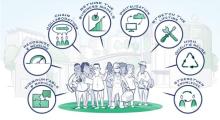
Major Cities in Europe - like Budapest, Copenhagen, Helsinki, Ljubljana, Oslo, Prague and Tirana - have signed the European Circular Cities Declaration inviting peers to join them! The have committed themselves to leading the circular transition and to new models of production and consumption, whilst improving human wellbeing and reducing emissions.
On 23 July 2020, Chile, The Netherlands, and Slovenia are again joining forces to create a circular future, discussing how to achieve sustainable recovery in Chile and what is the role of the circular economy.
The webinar is organised in the context of the United Nations High-Level Political Forum (HLPF) on Sustainable Development. It will look into practical ways to accelerate a just transition to a circular and carbon-neutral economy in order to achieve the Sustainable Development Goals (SDGs), while engaging all sectors of the economy and society.
The webinar session titled "Artificial Intelligence and Circular Economy" is part of a series of online events by Tondo. It will held on 9 July 2020 at 6 p.m. (in English with the support of slides).
Public consultation on boosting the renovation of buildings across the EU launched by the European Commission in order to gather views and input from a broad range of stakeholders, including national, regional and local authorities, businesses, unions, civil society organisations, education organisations, consumer groups, research and innovation organisations, as well as individual citizens.
Society and businesses are becoming increasingly aware that the resources needed for products are not infinite. There is growing pressure on the availability of resources due to a variety of factors including the expected increase in global consumption of goods spurred by a growing global middle class.
The report aims to introduce the various business risks of common ‘linear economy’ business practices and start a dialogue with the financial and business community about their implications. Building on this report, there is an objective to explore further directions to better understand and model them. Hopefuly, these risks will one day become an integral part of investment decisions to ensure better investment decisions that achieve long-term stability and growth.
This paper reviews the existing literature on modelling the macroeconomic consequences of the transition to a circular economy. It provides insights into the current state of the art on modelling policies to improve resource efficiency and the transition to a circular economy by examining 24 modelling-based assessments of a circular economy transition. Four key conclusions emerge from this literature. First, most models find that a transition to a more circular economy – with an associated reduction in resource extraction and waste generation – could have an insignificant or even positive impact on aggregate macroeconomic outcomes. Second, all models highlight the potential re-allocation effects – both between sectors and regions – of the introduction of circular economy policies.