The Expert Group on Circular Economy Financing has developed this guide to support public authorities in identifying the most suited incentives to speed up the transition towards a circular economy at national, regional or local level. Incentives aim at addressing market failures that prevent or delay the transition towards circular products, services and solutions.
The report focuses on combining life cycle assessment and circularity assessment to analyse environmental impacts of the medical remanufacturing of electrophysiology catheters.
Health Care Without Harm has recently developed a set of global principles for sustainable healthcare waste management. This position paper builds on those principles and focuses on the situation in Europe – particularly with reference to the EU Circular Economy framework.
This Circular Procurement toolkit outlines how businesses can redesign their procurement processes for greater ‘circularity’. This means maximising the value of products and materials while in use and recovering and repurposing them at the end of their lives, eliminating waste. This toolkit contains six simple steps for any business beginning their circular procurement journey.
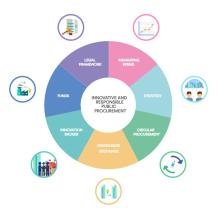
This E-Learning module on Innovative and Responsible Public Procurement guides learners, for instance, through the process of building a procurement strategy and procuring in a circular way.
This new UNEP report highlights the critical role of financial institutions in advancing the growth of circularity by investing in businesses that take a more sustainable approach to production and consumption.
The Ellen MacArthur Foundation's new report highlights rapid growth in circular economy financing and investment, and describes how investors and the banking and insurance industry are capitalising on the resulting opportunities.
The travel & tourism industry has touchpoints with most, if not all, key value chains and material flows in society and is therefore very relevant to consider for the circular economy transition.
To guide a sustainable recovery and development of the industry post COVID-19, this publication introduces key circular economy principles and concepts in the context of travel & tourism.
Circular Public Procurement (CircularPP) is a 3-year project (2017–2020) supported by the Interreg Baltic Sea Region programme. CircularPP has published Recommendations to national policy-makers on circular public procurement.
The European Investment Bank's Circular Economy Guide aims to promote a common understanding of circular economy, and raise awareness about and promote circular solutions.
The Guide provides information about EIB’s lending and advisory activities in this field, and communicates the vision of how the EIB can further support the transition to a circular economy.