The 2024 ASEAN Circular Economy Forum (ACEF2024) will focus on Guiding the Transition – ASEAN and EU Approaches to Circular Innovation and Entrepreneurship.
The Forum aims to support innovation and entrepreneurship for a circular transition, showcase existing circular economy practices in the ASEAN region and build on ASEAN's traditions and values for a circular transition.
The Green Deal, Circular Economy and Industrial Ecology Symposium 2024 will take place on 5-6 December at the MSH Clermont in Clermont-Ferrand. It will bring together researchers and practitioners who will present their research on industrial ecology and circular economy.
The European Sustainability Congress 2024 is one of the biggest international events focusing on the circular economy and sustainable development.
It aims to promote the idea of the circular economy, support sustainable business models and establish cooperation between interested stakeholders. The Congress will be the focal point of Circular Week 2024 and is organised by INNOWO - Institute for Innovation and Responsible Development and Polish Circular Hotspot, in cooperation with the European Circular Economy Stakeholder Platform.
PRIMUS was a research project funded under the Horizon Europe programme, which ran from 2022 to 2025. It researched new polymer recycling technologies, with a view to producing new recycled materials that meet the requirements for manufacturing high value products.
It produced a webinar series on Boosting Plastic Recycling and a number of training courses.
The Climate Change Summit (CCS), the largest event in Central and Eastern Europe (CEE) to focus on climate solutions, will bring together leaders in climate innovation, policy, entrepreneurship and government to discuss climate action and green economy opportunities.
Experts will work together to identify local and regional solutions for a sustainable future.
BUILD UP, the European portal for energy efficiency and renewable energy in buildings, is hosting the fourth in a series of six webinars organised with the CircularB COST Action project. This one will focus on Building Design Teams and Building Users, Facility Managers and Owners.
Re-think Taranto 2024 will explore macro-trends, possible evolutionary paths and key circular economy projects at local, national and international level.
The event will focus on Energy transition and sustainable mobility, Water management and the blue economy and Using materials and waste.
Wales (Cymru in Welsh) will be hosting the 2024 European Circular Economy Hotspot: Circular Economy Hotspot Cymru in Cardiff on 7 - 9 October.
This summit will be an opportunity to find out about Wales' circular economy achievements and aspirations, and learn about circular economy solutions from the public sector, private sector and communities from Wales and beyond. Participants will be able to engage with Welsh projects across industry, business, public bodies, academia, and towns and cities.
There will be global circular economy innovators, leaders and thinkers, so it's a good chance to forge links and network.
The transition towards a circular bioeconomy is crucial for meeting the goals of the European Green Deal and the Circular Economy Action Plan and for tackling the climate and biodiversity crises.
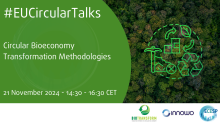
Following on from COP16 on Biological Diversity and on the same day that delegates will be discussing nature and biodiversity at COP29 on Climate Change in Azerbaijan, the ECESP Leadership Group on Circular Bioeconomy invites you to join the #EUCircularTalks on Circular Bioeconomy Transformation Methodologies.
On 5 September, ZeroW will be holding a workshop bringing together a diverse group of stakeholders, research institutions, startups, industry associations, regulatory authorities and more. They will discuss how to market innovative food loss and waste solutions produced during the research and development stage of EU projects.