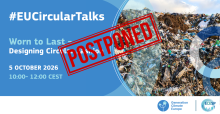
This #EUCircularTalk will present the key findings of Generation Climate Europe's report on textile waste in the European Union.
The session will explore the challenges involved, look at policy developments and shine a spotlight on practical examples from across the textile value chain.
Bringing together perspectives from retail, consumer protection and regional transition policy, this #EU Circular Talk will discuss how businesses, policymakers and other stakeholders can create conditions in which circular solutions become easier to access, more affordable and more trustworthy.
What has to change so that circular living does not depend on individual heroism, but becomes the default option? This session will seek to provide an answer!
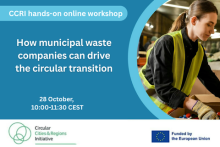
Municipal waste companies have the potential to do more than collect waste. This webinar will look at how they can enable local circular economy transitions.
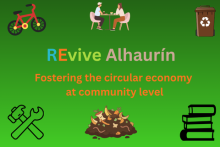
REvive Alhaurín puts the circular economy into action at community level.
It encourages local people to opt for repairing and sharing items rather than buying new ones, and provides useful advice on how to be a more responsible consumer.
Miogas supplies a range of biodigesters suited to families all the way up to large companies. The plants use bacteria to convert food scraps or animal manure into biogas and garden fertiliser. Reduce waste and your energy bill!
By bringing together businesses, public administrations, knowledge centres and civil society, connecting knowledge and capabilities, mobilising projects and supporting partnerships, reN helps translate strategy into viable, collaborative and scalable initiatives.
reN aims to accelerate the transition towards a circular tourism system and generate knowledge and experience that can inspire other island and tourism destinations.
This position paper synthesises youth perspectives on the EU Circular Economy Act through a consultation survey of 57 responses across Europe, a youth check at the ECESP Annual Conference 2026 and additional qualitative stakeholder input.
There are two main parts: Youth Priorities: What the Act Still Needs identifies what young people consider is missing or insufficiently addressed in the current framing of the CEA. From Policy to Practice: What Effective Implementation Needs explains how these priorities could be addressed through the Act and its implementation.
The paper concludes that lower material demand, durable product design, reuse, effective collection systems and strong public governance play a key role: recycling is not enough.
EESC member Cillian Lohan discusses why the CEA should mark a systemic shift in EU industrial policy, the role of public procurement in driving demand for circular products, and how Europe can reconcile reindustrialisation with lower resource consumption.
Vorarlberg's annual Environmental Festival is designed to produce as little waste as possible, to promote reuse and generally to familiarise people with the concepts of the circular economy without preaching about it.
People come for the festival experience but leave having learned why it's a good thing to donate what you don't need and not to produce extravagant amounts of waste!