Extended Producer Responsibility (EPR) is one of the key policies requiring EU Member States to organise separate collection of textile waste as of 2025. EPR schemes are an important tool for reducing the environmental impact of textiles, promoting circularity and contributing to more efficient end-of-life management.
Join the hybrid event on EPR for circularity: towards a more sustainable EU textile sector on
29 November from 15:00 to 17:30 CET at the European Parliament or online.
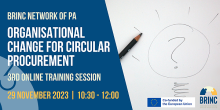
While procurement can be an accelerator for circular economy in organisations, scaling up the positive outcomes of successful pilots can be difficult, due to specific internal agreements, culture and values (organisational attitude).
This third training session of the BRINC Network of Public Authorities will provide suggestions and advice on how to change and evolve governance structures (mindset, attitude, culture), to support the implementation of circular economy within your organization.
A Circular Economy and Resource Efficiency conference with a multi-disciplinary perspective on how circular economy can be deployed to effect change in the day-to-day practice will be held in in Trondheim (Norway) and online by NTNU Sustainability.
Health Care Without Harm (HCWH) Europe is announcing a one-day event focusing on Circular Healthcare. Their training session to be held in Brussels on 28 November 2023 is aimed at transforming how to approach healthcare practices and implementing principles from the waste hierarchy in the sector.
Its objectives:
Learn how to reduce plastic and its impacts on health and the environment
Discover how to prevent waste and introduce reusable alternatives in healthcare settings
Explore how to eliminate harmful chemicals from healthcare products and processes
Engage in discussions on sustainable procurement and circular business models for healthcare
Network with fellow Circular Healthcare practitioners and innovators from across Europe.
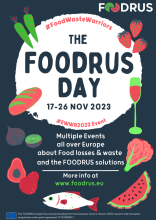
On 17–26 November 2023, the #FoodWasteWarriors campaign under the FOODRUS project hosts multiple events in various European countries. The diverse activities include stands at canteens in Brussels, a food upcycling meeting at the University of Copenhagen, a replication workshop in Hungary, and awareness campaigns in Spain, Denmark and Bulgaria.
The FOODRUS Day and all its events are part of the European Week of Waste Reduction 2023 (EWWR).
Pathways2Resilience is a flagship project under the EU Mission on Adaptation to Climate Change, working to empower 150 regions in developing transformative adaptation plans.
Join the Pathways2Resilience launch conference on 23 November and help shape a common vision for regional climate adaptation.
On 23 November (15:00-16:30 CET), the Green Growth Knowledge Partnership (GGKP) and Global Opportunities for Sustainable Development Goals (GO4SDGs) will host a webinar on “Circular economy: raising climate ambition”.
The first in a series accompanying multilateral meetings over the next 12 months, this webinar will explore how applying the circular economy approach can support the goals of COP28.
Plastic multi-layer composites are often used to package food in a functional and safe way. However, current recycling technologies are unable to reprocess these multi-layer composites into high-quality materials and so they are excluded from the circular economy.
For flexible food packaging, recyclability is even more complicated due to the high hygiene and safety standards that recyclates must meet when reused in contact with food. This is why CIRCULAR FoodPack is developing innovative solutions along the entire recycling value chain to make flexible food packaging circular.
At the Circularity FoodPack conference on 23 November, project partners and experts will present the latest findings and developments.
The Asia-Europe Environment Forum supports entrepreneurs committed to driving circularity in their businesses and provides an opportunity to discuss the circular transition of SMEs. This year, the Forum will be organising a conference on Empowering innovation in Asia & Europe - SMEs at the heart of circular transition, to take place on 21 and 22 November in Brussels.
CircularInvest and DEFINITE-CCRI are launching the Circular Investment Readiness Network, a Europe-wide community of practice to help circular economy projects overcome development and funding challenges.
The initiative will officially kick off online on 21 November, from 10:00 to 12:00 CET.