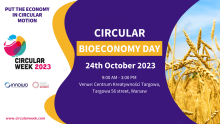
The Circular Bioeconomy Day on 24 October serves as a platform for sharing knowledge about bio-based solutions in the spirit of interdisciplinary cooperation.
The event is a part of Circular Week 2023 and brings together a diverse group of stakeholders, including policymakers from the EU, regional government representatives, local administration, businesses, NGOs, academia visionaries, thought leaders and experts, to celebrate and explore the remarkable potential of the circular bioeconomy and the pivotal role of its strategies in driving the transition towards a circular economy.
Biodiversity and Climate change are interconnected issues, with ecosystems and biodiversity playing a crucial role in regulating our climate. Circular procurement can contribute to mitigating climate change and preserving biodiversity by minimizing greenhouse gas emissions and protecting natural habitats.
Join us on 20 October 2023 at 10:00 - 12:30 CET for an inclusive dialogue and collaboration with stakeholders to bring together a diverse range of participants to work towards our circular economy goals. Our panellists will delve into the synergies between Circular Procurement and Biodiversity/Climate, two crucial topics for sustainable development.
Re-think Circular Economy Forum is an event designed to present a vision on macro-trends, possible evolutionary paths, and main projects concerning the Circular Economy on a local, national and international level. It wants to encourage the development of Circular Economy in Taranto and in the rest of Apulia territory.
Join the launch of the Global Action Partnership for Extended Producer Responsibility (GAP for EPR) on 19 October at 14:00 CEST!
GIZ, WWF and the OECD are partnering up to establish the Global Action Partnership for Extended Producer Responsibility, hosted by the PREVENT Waste Alliance. This partnership also receives circular economy support from the Ellen MacArthur Foundation and is working closely with UNEP to provide technical support to governments and PROs. Register now for this online event!
Delivering a just and successful circular economy transition requires engaging a multitude of stakeholders at the nexus of several areas of expertise, including digitalisation, agriculture, business management, governance and policy, innovation and finance.
This autumn, on 18 and 19 October, UNECE, in collaboration with the Ministry of Environmental Protection of the Republic of Serbia, will organise the first in-person Regional Policy Dialogue under the Stakeholder Engagement Platform - Circular STEP.
Nordic Circular Summit is the biggest annual conference on the circular economy in the Nordic region. NCS2023 will take place on 17–18 October, both in person in Reykjavik, Iceland and online. It will be co-hosted by Nordic Circular Hotspot and Nordic Innovation and is an official World Circular Economy Forum Side Event and a pre-event to the prestigious Arctic Circle Assembly.
As part of London Circular Economy Week, CLG Europe’s Materials and Products Taskforce will be hosting a webinar setting out EU circular economy policy.
Public authorities - policymakers, procurement professionals, local and regional authorities, and other public sector actors - have an important role to play in the transition towards a more circular built environment and have a range of policy levers at their disposal to stimulate demand for circular skills. Using circular strategies in the built environment can help reduce the embodied emissions of building materials by 50%.
This interactive webinar will show how to train staff and how local authorities can work with stakeholders to train the whole value chain to promote circularity.
The webinar will present the guidance for policymakers as well as training materials developed by the BUS-GoCircular project. It will also explain how public authorities can use the Fundamentals Training Packs for SMEs in their requirements in tenders.
Despite growing efforts by political bodies, companies and researchers to support the transition towards a more sustainable and circular economy, we are still behind schedule.
The seminar on 17 October will address the following challenges that are slowing down this transition:
the need for quantitative but easy-to-handle methods to support decision-making in the product design phase, particularly concerning material selection for sustainability,
the potential rebound effects that undercut the expected sustainability gains of moves towards circularity.
EU-funded projects CircularInvest and DEFINITE-CCRI are organising an engaging webinar on driving circular innovation in urban environments. It will offer insightful discussions, inspiring stories and opportunities for project development and collaborative networking, as the transformative power of circular practices in cities is explored.