For the EU’s Green Deal to be effective, it is critical to target the root cause of the triple environmental crises of climate change, pollution and biodiversity loss: excessive extraction, production, manufacturing and consumption of material resources.
This excess is not evenly distributed in the world: as highlighted in the report, the EU consumes more than its fair share – levels that are almost double the estimated sustainable consumption levels.
Addressing material resource consumption by establishing an EU Material Resources Law will be critical to meet the fourfold objectives set out in the Circular Economy Action Plan (CEAP) and stay within planetary boundaries. The EU will not achieve its climate change targets without making progress on resource consumption.
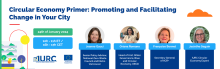
This webinar on 24 January will introduce key organisations and resources at the regional and national levels, as well as host a first discussion amongst participants on experiences, interests, and challenges for cities and regions to enable a transition to a circular economy.
This COP28 side event has been organised by the EESC, the European Commission and the Coordination Group members of ECESP. It took place on 10 December in Dubai, focusing on Accelerating the financing of the circular economy in climate and biodiversity strategies.
FOODRUS is a European Horizon 2020 project aiming to build resilient local food systems in Europe by developing circular solutions to limit food loss and waste along the agri-food value chain. As part of this mission, FOODRUS will be holding three workshops in Spain on 31 January and 1 February 2024 during the FOODRUS: Reduciendo el desperdicio alimentario (#ReducingFoodWaste) event.
Following the success of the first FOODRUSroundtable in October 2023, on Tuesday 23 January, ACR+ will be holding the second policy roundtable on Recommendations to Overcome Barriers in Food Waste Prevention and Reduction. It will take place online from 15:00 to 17:00 CET and you are all welcome to participate!
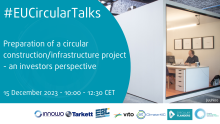
This EUCircularTalks event on “Preparation of a circular construction/infrastructure project - an investors' perspective" took place on 15 December at 10:00 - 12:30 CET. Various aspects of circular construction and infrastructure projects were explored.
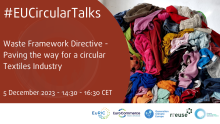
New waste management policies will change the way the EU handles textiles waste. The proposal for a new Waste Framework Directive aims to accelerate the development of the separate collection, sorting, reuse and recycling of textiles, in line with the EU Strategy for Sustainable and Circular Textile and the Circular Economy Action Plan.
On 5 December 2023 at 14:30 - 16:30 a discussion between stakeholders in the value chain will focus on how the sector sees the implementation of the Waste Framework Directive and the Extended Producer Responsibility for textiles in practice.
The Biomodel4Regions project, with the help of ICLEI Europe, is looking for two regions or clusters in Northern, Mediterranean, Eastern or Central-Western Europe keen to develop their own bio-based economy strategy covering agri-food, forestry, shellfish or Organic Fraction of Municipal Solid Waste (OFMSW).
Interested regions can apply up until 1 December 2023.
Since its inception, the EU Eco-Management and Audit Scheme (EMAS) has sought to be a tool to help companies reduce their environmental impact and gain acceptance in their area by being transparent about their environmental performance and maintaining an open dialogue with stakeholders.
But how can you involve staff in environmental management?
How are the EMAS tools helping to involve staff and top management in reducing environmental impacts and enhancing resource efficiency?
What good practices has EMAS identified for involving employees and stakeholders in its 30 years of experience?
Do people recognise the importance of their day-to-day behaviour in achieving environmental improvements at work and at home?
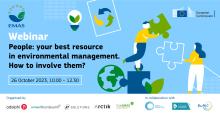
To answer these questions and have an interesting discussion with the audience, EMAS and ECESP organised a webinar on 26 October 2023, to learn more about EMAS and the importance of involving staff, top management and stakeholders in the circular transition.
On 6 November 2023, Arthur ten Wolde, ECESP Coordination Group member and Executive Director of Ecopreneur.eu, represented the Platform at a G7-B7 online meeting on Circular Economy and Resource Efficiency Principles. Mr Ten Wolde has been a member of the European Circular Economy Stakeholder Platform since its foundation in 2017.
The meeting was organised as part of the G7 Sapporo Ministers’ Meeting on Climate, Energy and the Environment in Japan. The Group of Seven (G7) is an intergovernmental political forum consisting of Canada, France, Germany, Italy, Japan, the UK, the USA and the EU. TheBusiness7 group (B7) is the G7 platform for dialogue with the international business community, consisting of the industry and employers’ associations from the G7 including BusinessEurope.