Join the PACCT webinar on 7 November 2024, from 11:00 to 12:00 CET, to discover the white paper on Product-as-a-Service titled "Business Model Innovation for Sustainable Impact in Europe."
They will talk also about PACCT 2025 and you will be able to ask them any questions.
The transition to zero emission and energy positive buildings, neighbourhoods and communities is key to unlocking the EU's climate and energy ambitions by transforming both new and existing buildings into drivers of decarbonisation.
This policy recommendation paper puts forward 10 key policy recommendations for national and regional policy makers for overcoming financial barriers for building renovation and transforming existing buildings into zero emission or positive energy neighbourhoods by 2050.
The recommendations are based on experiences and learnings from 8 research and innovations projects in Europe, including 33 demonstration sites around Europe.
ADVANCE Circular is an Erasmus+ project, focusing on linking the tourism industry with VET (Vocational Education and Training) to embrace circularity. The brochure describes the project which aims to assess the readiness of the tourism sector and VET institutions for adopting circular principles in Bulgaria, Romania, Slovenia and Spain.
"Are we ready for circularity?" is part of the second stage (Mapping the Scene & Creating Bridges). It finds that despite progress in raising awareness of circularity, significant efforts are needed to overcome financial, educational and regulatory barriers. Strengthening strategic partnerships, increasing funding support and enhancing training opportunities will be vital to advance circularity readiness in the tourism and VET sectors in these countries.
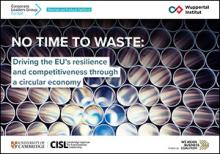
Sanna Markkanen, Anum Sheikh, Diana Potjomkina, Martin Porter, Bianca Drotleff (CISL), Bettina Bahn-Walkowiak, Thomas Götz, Henning Wilts (Wuppertal Institute), with support from Giacomo Sebis and Krisztina Zálnoky.
This report delves into the business case for accelerated EU action on the circular economy.
It provides policy recommendations for the forthcoming Circular Economy Act, focusing on the business perspective and how the Act could support the EU’s resilience and competitive sustainability. It highlights barriers and actions identified by companies across various sectors.
The report stresses that a more ambitious and integrated approach, driven by the Circular Economy Act and other strategic EU initiatives, is essential for achieving the EU’s broader goals of climate neutrality, industrial success and social equity.
The authors aim to improve the understanding of both businesses and policy makers about the urgent need to accelerate the circular economy transition.
LIAISE is a research network set up by COST. To put it in words rather than acronyms, it’s a four-year research network focusing on Cooperation, development and cross-border transfer of Industrial Symbiosis among industry and stakeholders which was set up under European Cooperation in Science and Technology.
Up2Circ is an international project funded by the European Commission’s Horizon Europe programme. The overall aim is to help European SMEs go circular.
The project assists SMEs: there are awareness-raising and training modules and information on how to apply for EU funding. The platform has prepared a catalogue of its success stories.
The platform is also building a network of stakeholders: people with access to many SMEs, expertise in a given sector and/or the circular economy, advanced technologies or social innovation. These people will have access to Up2Circ's tools for helping SMEs.
The website also has information on circular events. The project organisers have experience with assisting SMEs; with this project they are focusing on the circular dimension.
The Horizon Europe POLYMEER project aims to establish a sustainable bio-based value chain for bioplastic products. By efficiently converting wet brewers’ spent grain into high added value materials, it is endeavouring to diversify the array of innovative material solutions capable of replacing traditional plastics.
The report presents the progress the Commission has made in implementing the 2022 strategy for the outermost regions. It shows that the Commission has delivered on its commitment to reflect the outermost regions’ characteristics in legislative proposals, policy initiatives and programmes.
The outermost regions have high potential to develop circular economy solutions. Cohesion policy supports circular economy development there. Both the ERDF and Interreg support waste management and recycling, for instance in Réunion with EUR 18 million of ERDF funding dedicated to the circular economy. Outermost regions also benefit from support under the LIFE programme. Several of these regions have designed circular strategies, such as the Circular Economy Conference of the Azores.
Are you interested in seeing how the circular bioeconomy can drive the development of sustainable agri-food systems across rural and urban areas in the EU? The EESC is organising a webinar on this very issue - hear what they have to say and ask your questions!