GIND is an innovative company dedicated to developing sustainable and long-lasting solutions for road surfaces and outdoor spaces. Its BIO DILE™ joint filler replaces traditional, resource-intensive and short-lived materials with more environmentally-friendly alternatives made from recycled, sun-dried stone aggregates and bio-based binders derived from cashew nut shells and natural asphalt. At the end of the filler's lifecycle, it can be fully recycled.
On 12 November, the European portal for energy efficiency and renewable energy in buildings BUILD UP is hosting the sixth and last webinar, part of a series of six webinars organised with the COST Action project on ‘Stakeholder Webinar Series – Deconstruction and Demolition Teams & Waste Management Industry’.
Renewaball introduced the world’s first fully circular tennis and padel balls, designed with recycled materials sourced from used balls collected across European clubs.
This project embodies eco-friendly design by reusing rubber from old balls and using biodegradable wool felt to replace conventional polyester and nylon, which reduces microplastic pollution.
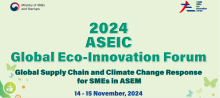
The ASEM SMEs Eco-Innovation Center will be hosting a Global Eco-Innovation Forum under the heading Global Supply Chains and Climate Change Response for SMEs in ASEM.
The forum is a unique opportunity to explore the latest strategies enabling SMEs to respond to climate change and adapt to global supply chain regulations. It will provide insights into supply chain regulations and climate change responses for SMEs and startups.
Businesses in India and around the world are adopting the circular economy as a new production paradigm. However, while the economic and environmental dimensions of the circular economy have been explored, its social impact (decent pay, gender equality, labour conditions) has been overlooked.
By surveying 100 workers and interviewing 40 managers in India, the authors developed an inventory of circular jobs with the respective demographic. They found that circular jobs in India are of low quality due to relatively low wage and job security indicators (especially for female workers). Informal migrant women in resale, repair and recycling are most vulnerable. Resale and rental based on internet platform models have the highest earning quality for men and women.
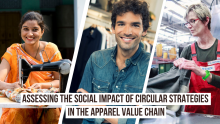
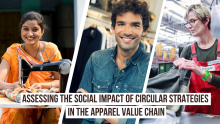
The apparel value chain is essential for the livelihood of millions of workers around the globe, but working conditions in this sector are far from satisfactory. The circular economy has been used by businesses as a framework for achieving sustainability but there is a lack of knowledge about its social impact.
This paper explores the social impact of the different circular strategies implemented in the Netherlands, Spain and India. It assesses social impacts related to the quality of jobs, workers’ sustainable livelihood and gender equality and inclusion.
It finds that the social ambition of the circular economy is low, and that current circular strategies follow the same feminisation and precariousness of working conditions found in the linear apparel value chain.
Brazilian Circular Hotspot will bring together experts and business and government representatives from around the world to discuss the challenges and opportunities in transitioning to a more circular economy.
As part of the official agenda of the World Circular Economy Forum (WCEF), the Brazilian Circular Hotspot will be a landmark in Brazil, inspiring and preparing society for the circular transition.
This paper examines the socio-environmental justice aspects of 11 key EU policies guiding the textile industry's journey towards circularity.
It found that action is needed to tackle overproduction and overconsumption in the EU Strategy for Sustainable and Circular Textiles. Steps must be taken to address the impacts of EU circular economy textile policies on the Global South so as to ensure positive social and environmental outcomes.
The paper also concluded that efforts are needed to make just transition policies globally accountable and alleviation mechanisms integral to the Textile Strategy rather than supplementary corrective measures. Meaningful participatory mechanisms are needed that ensure the democratic inclusion of different views and actors.
If your role requires you to lead change, then this conference is for you. It's intended for executives responsible for managing organisational transformation.
Change makers from around the globe will present cutting-edge technologies and strategies to help you deliver better results and generate more value. In her session, Ladeja Godina Košir, founder and Executive Director of Circular Change and Co-Chair of ECESP, will explore three strategies for integrating industries, policies and international partnerships in order to create a circular economy.
The “Greentech and Circular Economy Innovation” is looking for start-ups and SMEs that are developing innovative solutions for improving refinery waste management, remediating soil and water contamination and improving energy system efficiency.