Circular ReBoundary is intended for professionals interested in circular economy practices. It is particularly relevant for the buildings, mobility and manufacturing sectors, but the rebound effects and stakeholder testimonials sections offer insights applicable across all industries.
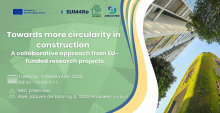
The workshop will bring together EU policymakers, researchers and construction stakeholders to explore how innovative materials, digital technologies and reuse strategies can together advance circularity in Europe’s built environment.
It aims to mirror the circular lifecycle of materials, from innovation and data acquisition to reuse and regeneration, and show how circular economy principles can be embedded into the construction sector.
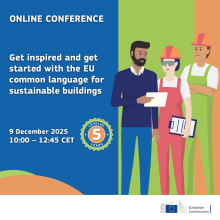
The European Commission's Directorate-General for the Environment invites professionals in the built environment sector to join an online conference marking the fifth anniversary of Level(s): the EU common language for assessing and measuring the sustainability performance of buildings.
Find out how it works and what training materials are available to help you!
On 7 November, the Commission granted over EUR 358 million to 132 new projects across Europe under the LIFE Programme for environment and climate action. Read about a few of the projects selected to promote the circular economy!
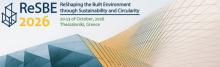
ReSBE 2026 aims to redefine how the built environment is designed, constructed, operated and renewed. It will bring together researchers, practitioners, innovators and policymakers to explore transformative solutions for a regenerative future.
Participants will gain insights across circular design and construction, digitalisation and innovation, lifecycle assessment and metrics, climate adaptation and resilience, policy and governance, market transformation, and society and education.
The CityLoops project was a Horizon 2020 project which ran from 2019 to 2023. It focused on circular economy solutions for bio-waste and construction and demolition waste (CDW). The project produced various tools, including this circularity assessment.
The CityLoops project was a Horizon 2020 project which ran from 2019 to 2023. It focused on circular economy solutions for bio-waste and construction and demolition waste (CDW). The project produced various tools, including this assessment method.
The CityLoops project was a Horizon 2020 project which ran from 2019 to 2023. It focused on circular economy solutions for bio-waste and construction and demolition waste (CDW). The project produced various tools, including this toolkit.
The CityLoops project was a Horizon 2020 project which ran from 2019 to 2023. It focused on circular economy solutions for bio-waste and construction and demolition waste (CDW). The project produced various tools, including this handbook.