The European Commission's Joint Research Centre is organising a second consultation meeting with stakeholders as part of its ongoing work on a preparatory study on textile products. This will support the implementation of the recently adopted Ecodesign for Sustainable Products Regulation.
The ASEM SMEs Eco-Innovation Center will be hosting a Global Eco-Innovation Forum under the heading Global Supply Chains and Climate Change Response for SMEs in ASEM.
The forum is a unique opportunity to explore the latest strategies enabling SMEs to respond to climate change and adapt to global supply chain regulations. It will provide insights into supply chain regulations and climate change responses for SMEs and startups.
CIMPA (A CIrcular Multilayer Plastic Approach for value retention of end-of-life multilayer films) is an EU-funded H2020 project working on developing a recycling value chain for post-industrial and post-consumer multilayer films (from food and agricultural applications).
The project will shortly be holding its final event where it will showcase its key findings. There will also be information on clustering initiatives on circular plastics and recommendations from policy makers, industry leaders, researchers and NGOs on unlocking the potential of plastic film recycling. The event will conclude with an opportunity for networking and a poster session highlighting new technologies which can enhance plastics recycling.
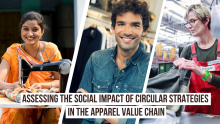
This paper examines the socio-environmental justice aspects of 11 key EU policies guiding the textile industry's journey towards circularity.
It found that action is needed to tackle overproduction and overconsumption in the EU Strategy for Sustainable and Circular Textiles. Steps must be taken to address the impacts of EU circular economy textile policies on the Global South so as to ensure positive social and environmental outcomes.
The paper also concluded that efforts are needed to make just transition policies globally accountable and alleviation mechanisms integral to the Textile Strategy rather than supplementary corrective measures. Meaningful participatory mechanisms are needed that ensure the democratic inclusion of different views and actors.
The European Commission's DG Environment is organising an online conference exploring Level(s), the EU common language for assessing and measuring the sustainability performance of buildings. It's intended for anyone working in the built environment sector.
The Level(s) foundations conference will enable participants to get informed, get inspired and get started with the EU approach to building sustainably.
Over the last 3 and a half years, the CIRCULAR FoodPack consortium has worked on circular design for flexible packaging. It has demonstrated the various steps required to obtain post-consumer recyclates and shown how to integrate them into new packaging which meets the high standards for food protection and safety.
Attend their final event and see what they learned!
Transformative circular futures in the textile and apparel value chain: Guiding policy and business recommendations in the Netherlands, Spain, and India
Circular economy practices are gaining importance in the global textile and apparel value chain. However, the circular economy's social dimension is often overlooked.
To address this problem, this study develops transformative circular futures (TCFs), co-created circular economy scenarios that are diverse and systemic and embed social impact considerations. The aim is to inform policy and business decision making in the textile and apparel value chains of India, the Netherlands and Spain.
The study recommends normalising living wages for direct, indirect and informal workers, implementing regulations challenging the patriarchy, eliminating gender pay and establishing permanent global committees of social actors.
circulareconomy.earth is a project set up by Chatham House's Environment and Society Programme. It enables users to explore the policy and trade dynamics associated with transitioning from a linear to a circular economy model, as well as providing analyses of the associated opportunities and trade-offs.
This programme builds on the solid foundations laid by previous programmes.
Chapter 1 sets out a vision of the circular economy up to 2030 and 2050.
Chapter 2 addresses general measures used to help deliver a circular economy in the Netherlands. They affect the various phases of the product value chains.
Chapter 3 describes measures that relate to specific product groups, such as furniture, plastic packaging and housing.
Chapter 4 addresses supporting measures for a number of topics, such as knowledge & innovation, the Circular Netherlands Accelerator!, market incentives, financing instruments and circular procurement.
Chapter 5 covers the collaboration between the parties involved in this programme.
Chapter 6 describes which resources are available for the plans in this programme.