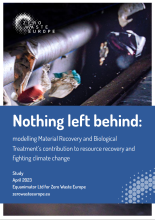
A new report by Zero Waste Europe demonstrates how Material Recovery and Biological Treatment (MRBT) systems are a cost-effective approach to treating (leftover) mixed waste.
The study Nothing left behind: modelling Material Recovery and Biological Treatment’s contribution to resource recovery and fighting climate change focuses on the technology that combines the use of advanced sorting systems applied to mixed waste (to extract additional material for recycling) with biological treatment of the remaining residual waste aimed at stabilising the waste before its being landfilled.
This report from the HOOP Project describes the methodological approach for identifying circular business models for bio-waste.
It presents an analysis of the business models behind 15 successful solutions for bio-waste valorisation and proposes a template business canvas for bio-waste valorisation. The report also presents a new integrated circular business model typology focused on bio-waste, along with drivers and barriers related to the implementation of circular business models in bio-waste valorisation.
A Biowaste Club is an institutionalised platform for multi-stakeholder engagement whose members are all local and regional actors along the biowaste value chain, such as waste management companies, research institutions, public authorities, etc.
Biowaste Club meetings take place twice a year, set-up and formats can vary, depending on the local needs and, consequently, on their agenda.
The City of Roubaix's Circular Economy Unit is hosting the Roubaix Circular Economy Forum on 30 and 31 March 2023. This event aims to bring people together (everyone from members of the public to CEOs and European partners) to explore and raise awareness about the circular economy.
This in-person event in Brussels on the morning of 17 May will explore some of Europe’s best practices on waste prevention, implemented by coastal municipalities and regions.
It will bring together local actors behind these best practices and representatives from Brussels, in order to better understand how local actions can inform key forthcoming legislative decisions on plastic production, use and waste.
Tyres are complex products essential to the mobility of millions of Europeans. Likewise, tyre recycling is essential to the sustainability of the entire tyre value chain, be it in terms of resource efficiency or climate neutrality. Yet, despite a landmark landfill ban in 2006, much needs to be done to improve the circularity of tyres. To give an order of magnitude, today, for one tyre that is recycled, one tyre gets incinerated for energy recovery, and the worse in terms of end-markets opportunities is yet to come.
The EuRIC conference on tyre recycling takes place in Brussels on 18 April 2023.
This report looks at whether, and to what extent, the EU recycling targets can be met through improved recyclability of packaging and increased separate collections of municipal waste.
It examines the role mixed waste sorting (MWS) could play in three EU countries with high recycling performance – Germany, Belgium, and Sweden.
The conclusion is that in addition to separate collection and improved recyclability of plastic packaging, a full roll-out of effective MWS is necessary to meet recycling targets consistently, and to ensure progress towards the EU’s wider carbon emissions reduction goals.
This conference brings together regional and national governments, mixed waste sorting operators, recyclers, experts, and technology providers from countries across Europe to share their expertise on the introduction of MWS as an additional tool for the recovery and re-circulation of Europe’s valuable resources.
The conference is a timely response to the current revision of the EU’s Waste Framework Directive and the Industrial Emissions Directive.
Interested in circular plastics? Join the interactive webinar "A Circular Economy for Plastics in Canada & the Netherlands" on 5 April to learn more about current policy approaches, best practices, latest technologies and market opportunities in the Netherlands and Canada.
The focus of this online event on 18 April is on what the Interreg NSR ProCirc project partners have learned and developed in circular procurement. The event will start with a plenary session in English and the participants will then dive into the results in three breakout sessions in different national languages:
From one circular pilot to circular economy on everybody’s lips
Setting goals & monitoring: how to measure impact
How to scale adoption through Joint Statements of Demand