People are ultimately the drivers behind environmental change. They are the ones who will help organisations make the necessary changes to implement an efficient environmental management system, reduce the organisation's environmental impact and become more circular as a business and, in general, as a society.
Since its inception, the EU Eco-Management and Audit Scheme (EMAS) has sought to be a tool to help companies reduce their environmental impact and gain acceptance in their area by being transparent about their environmental performance and maintaining an open dialogue with stakeholders.
But how can you involve staff in environmental management? How are the EMAS tools helping to involve staff and top management in reducing environmental impacts and enhancing resource efficiency? What good practices has EMAS identified for involving employees and stakeholders in its 30 years of experience? Do people recognise the importance of their day-to-day behaviour in achieving environmental improvements at work and at home?
To answer these questions and have an interesting discussion with the audience, EMAS and ECESP organised a webinar on 26 October, to learn more about EMAS and the importance of involving staff, top management and stakeholders in the circular transition.
On 26 October, Environment Park in Turin (Italy) will host the event Hydrogen as Sustainable Driver for Innovation - From the production to the final uses of hydrogen devices for a sustainable and circular supply chain.
Taking an overall lifecycle perspective to production, design, manufacturing and the final use of hydrogen devices, this event will explore the sustainability dimension of some of the main steps in the hydrogen value chain.
MAZOVIA CIRCULAR CONGRESS 2023 is one of the biggest and most prestigious conferences in Europe regarding the circular economy. Mazovia Circular Congress is the focal point of the Circular Week initiative, an international educational campaign about the circular economy and sustainable production and consumption.
This year, the organisers would like to contribute to and accelerate the transformation into a circular future. The event is geared towards public administration, local municipalities, companies, corporate social responsibility officers, sustainable managers, local administration, start-ups and media. It is being promoted broadly and so will also reach the general public.
The main objective is to educate people about the circular economy and sustainable development and promote sustainable businesses and solutions. The organisers would like to show what could be achieved by closing the loop and how sustainable consumption and production can have a positive impact on the environment, biodiversity loss and climate change. Through Circular Week, they would also like to promote effective and innovative green solutions and effective systemic changes. The event focuses on raising awareness and triggering behavioural change and engagement in the circular transition.
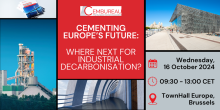
The European Commission is spearheading initiatives to reduce carbon emissions in European buildings, with particular emphasis on the embodied carbon in construction materials. The Whole Life Carbon Roadmap is set to be unveiled in autumn 2023, focusing on CO2 reduction throughout a building's lifespan.
Concurrently, the European cement industry aims to achieve carbon neutrality by 2050 and has already outlined its vision in the 2020 Carbon Neutrality Roadmap. The conference on 24 October will explore sustainable cement/concrete use in buildings, strategies to lower carbon footprints throughout building lifecycles, and the role of circularity in decarbonisation, while evaluating supportive policy frameworks.
The Circular Bioeconomy Day on 24 October serves as a platform for sharing knowledge about bio-based solutions in the spirit of interdisciplinary cooperation.
The event is a part of Circular Week 2023 and brings together a diverse group of stakeholders, including policymakers from the EU, regional government representatives, local administration, businesses, NGOs, academia visionaries, thought leaders and experts, to celebrate and explore the remarkable potential of the circular bioeconomy and the pivotal role of its strategies in driving the transition towards a circular economy.
Biodiversity and Climate change are interconnected issues, with ecosystems and biodiversity playing a crucial role in regulating our climate. Circular procurement can contribute to mitigating climate change and preserving biodiversity by minimizing greenhouse gas emissions and protecting natural habitats.
Join us on 20 October 2023 at 10:00 - 12:30 CET for an inclusive dialogue and collaboration with stakeholders to bring together a diverse range of participants to work towards our circular economy goals. Our panellists will delve into the synergies between Circular Procurement and Biodiversity/Climate, two crucial topics for sustainable development.
Re-think Circular Economy Forum is an event designed to present a vision on macro-trends, possible evolutionary paths, and main projects concerning the Circular Economy on a local, national and international level. It wants to encourage the development of Circular Economy in Taranto and in the rest of Apulia territory.
Delivering a just and successful circular economy transition requires engaging a multitude of stakeholders at the nexus of several areas of expertise, including digitalisation, agriculture, business management, governance and policy, innovation and finance.
This autumn, on 18 and 19 October, UNECE, in collaboration with the Ministry of Environmental Protection of the Republic of Serbia, will organise the first in-person Regional Policy Dialogue under the Stakeholder Engagement Platform - Circular STEP.
Join the launch of the Global Action Partnership for Extended Producer Responsibility (GAP for EPR) on 19 October at 14:00 CEST!
GIZ, WWF and the OECD are partnering up to establish the Global Action Partnership for Extended Producer Responsibility, hosted by the PREVENT Waste Alliance. This partnership also receives circular economy support from the Ellen MacArthur Foundation and is working closely with UNEP to provide technical support to governments and PROs. Register now for this online event!
Nordic Circular Summit is the biggest annual conference on the circular economy in the Nordic region. NCS2023 will take place on 17–18 October, both in person in Reykjavik, Iceland and online. It will be co-hosted by Nordic Circular Hotspot and Nordic Innovation and is an official World Circular Economy Forum Side Event and a pre-event to the prestigious Arctic Circle Assembly.