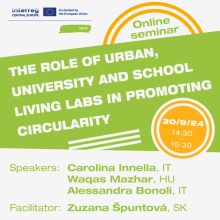
This online seminar on the role of urban, university and school Living Labs in promoting circularity is part of the From Niche to Centre - City Centres as Places of Circular Lifestyles (NiCE) project.
The circular economy is increasingly coming to be recognised as necessary - but more needs to be done to get the general public on board. Living Labs can help here.
How does digitalisation contribute to advancing circular procurement practices?
The ECESP Leadership Group on Circular Procurement organised the #EUCircularTalks webinar on 27 September at 10:00 – 12:00 CEST, offering valuable insights into global trends, practical tools, and real-world case studies. Participants had a chance to learn strategies to mitigate environmental and social impacts associated with ICT procurement and to implement sustainable procurement practices effectively.
You are invited to join the global virtual event convened by FAO and UNEP on Friday 27 September at 13:30 - 15:00 CEST in observance of the fifth International Day of Awareness of Food Loss and Waste.
CEWEP, the Confederation of European Waste-to-Energy Plants, will be holding its international conference on residues from waste-to-energy on 25 September in Mechelen, Belgium. Residue experts from across Europe will tackle topics such as environmental contribution, residue utilisation and material recovery.
There will be ample opportunity for networking during the breaks and the buffet on the evening of 25 September. On 26 September, participants can visit Indaver’s ash treatment facility.
The 6th European Recycling Conference, organised by EuRIC in partnership with Assofermet, will take place on 26 September in Milan, under the heading 'Recycling Today, Resourcing Tomorrow'. This event will also celebrate EuRIC's 10th anniversary: a decade of commitment to circularity and sustainable recycling practices.
Bio4HUMAN is a Horizon Europe-funded initiative working to solve solid waste management challenges in humanitarian settings.
This September, it will be holding a webinar on empowering the bio-based sector for solid waste management in humanitarian settings. The webinar will focus on the findings of their Humanitarian Needs Assessment Report and familiarise bio-based stakeholders with humanitarian settings and the challenges facing them in terms of solid waste management.
The European Sustainable Nutrient Initiative (ESNI) brings together leading experts in the field of nutrient cycling to foster collaboration among European entities engaged in nutrient recycling. The goal is to facilitate the exchange of valuable experiences and identify knowledge gaps to guide future research.
ESNI Conference 2024 will focus on nutrient recycling and reuse for more sustainable resource management.
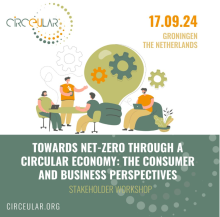
CircEUlar is a four-year European Research and Innovation Action. It began work in September 2022 and seeks to understand the dynamics and levers for transforming society into a net-zero emissions circular economy.
The CircEUlar project team is now organising a workshop where stakeholders will be able to hear about their latest research and contribute to shaping the next phases of work.
BUILD UP, the European portal for energy efficiency and renewable energy in buildings, is hosting the fourth in a series of six webinars organised with the CircularB COST Action project. This one will focus on Building Design Teams and Building Users, Facility Managers and Owners.
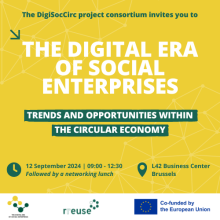
RREUSE, Europe’s largest network of social enterprises active in reuse, repair and recycling, is organising a conference to mark the end of the DigiSocCirc project, which aims to support, optimise and accelerate the role played by social circular enterprises in the digital era.
During the conference, the DigiSocCirc consortium will share the project’s key findings and facilitate panel discussions with representatives from social enterprises, businesses and policymakers.