Le Marché is based in Pakistan and active throughout South Asia, with partners in Germany, France, the UK and the US. It has a two-pronged approach: it collects textile waste and recycles it for use as a secondary raw material, and it uses fibres made from agricultural waste.
Maiano Re-Lab comes up with sustainable industrial applications for textile scraps from mass-produced consumer goods. This initiative establishes synergies between industrial sectors, minimising waste and promoting sustainability within the industry.
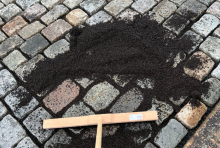
GIND is an innovative company dedicated to developing sustainable and long-lasting solutions for road surfaces and outdoor spaces. Its BIO DILE™ joint filler replaces traditional, resource-intensive and short-lived materials with more environmentally-friendly alternatives made from recycled, sun-dried stone aggregates and bio-based binders derived from cashew nut shells and natural asphalt. At the end of the filler's lifecycle, it can be fully recycled.
Renewaball introduced the world’s first fully circular tennis and padel balls, designed with recycled materials sourced from used balls collected across European clubs.
This project embodies eco-friendly design by reusing rubber from old balls and using biodegradable wool felt to replace conventional polyester and nylon, which reduces microplastic pollution.
Hailia’s patent-pending technology is transforming the seafood industry by upcycling fish sidestreams into high-quality, versatile food products. This technology can produce items with over 90% fish sidestream content - while being very tasty and suitable for a wide range of dishes.
The Dutch company Corbion grows microalgae in closed fermentation tanks where they transform sustainable sugars into algae in a few days. The algae are then used to produce omega-3 DHA (docosahexaenoic acid). These fatty acids provide essential nutrients for humans and many animal diets.
From its base in the northern Netherlands, JC-Electronics supplies new, refurbished and repaired industrial electronics. By giving used and defective devices a second life, the company contributes to the circular economy and helps customers reduce their carbon footprint.
The Czech company KOMA Modular s.r.o. is taking a new approach to construction: it manufactures modular buildings made up of individual prefabricated units. It's an effective method which avoids the whole material-intensive issue of construction and demolition.
With 14 automotive brands around the globe, Stellantis is a major industry player. In March 2022, it presented its Dare Forward 2030 strategic plan, aiming to achieve carbon net zero by 2038 while reducing its consumption of natural resources. The plan is steered by the Circular Economy Business Unit and is based on remanufacture, repair, reuse and recycle.