The European Commission recently adopted a legislative proposal to increase demand for low-carbon, European-made technologies and products. The Industrial Accelerator Act (IAA) aims to boost manufacturing, grow businesses and create jobs in the EU, while supporting industry's adoption of cleaner, future-ready technologies.
This conference will present leading solutions and innovations for replacing fossil carbon with biomass, CO₂ utilisation and recycling.
There will be three days of discussions and presentations, focusing on the defossilisation of the chemical industry, fossil-free plastics, and policies, frameworks and regenerative business models.
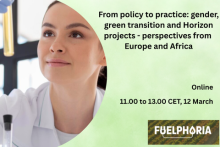
The FUELPHORIA project aims to establish sustainable, competitive and secure value chains for advanced biofuels and renewable fuels of non-biological origin.
This webinar explore how gender issues are addressed in Horizon projects and their link to the green and just transition.
Join us for a dynamic EU Circular Talk exploring how the EU Ecolabel acts as a ready-to-use tool helping businesses deliver circularity, meet rising legislative expectations, and gain a competitive edge across EU markets.
Bio-based plastics are wholly or partly derived from biomass and so help reduce reliance on fossil fuel-based plastics.
Feedstocks include primary and secondary sources. Agricultural and forestry residues and post-consumption organic waste have lower environmental impacts than primary feedstock but collection and transportation issues make scaling up a challenge.
As a whole, the sector is struggling to achieve real scale: bio-based plastics account for only 0.5% of global plastics production and are projected to reach 1% by 2030.
Scaling is hampered by feedstock sustainability, competitiveness, technological maturity and cost: currently, producing bio-plastic is generally 1.5 to 2 times more expensive than conventional plastics.
This briefing presents key air pollutant trends and projections for energy-intensive industries in Europe.
It looks at how greenhouse gas emissions have fallen over the past two decades, but improvements in this area have stalled in the last ten years. Further progress will require the implementation of environmental legislation and transformative change in emission-intensive processes.
The briefing also looks at decarbonisation and circularity. Both approaches, particularly electrification, offer significant co-benefits for pollution prevention. A clear understanding of these co-benefits and risks should be used to guide investments and maximise environmental, health and competitiveness gains.