Upload document

Academics for Circular Economy position paper on the EU Circular Economy Act

Academics for Circular Economy logo
Author
Julian Lauten-Weiss
Selin Gökkut
Priya Saikumar
Publication Date
11/2025
Language for original content

Academics for Circular Economy welcomes the creation of a Circular Economy Act that aims to address issues such as resource dependence, competitiveness, and environmental pressures. To leverage the full economic, social and environmental potential of the circular economy, the Circular Economy Act must address a number of critical points:

  • Competitiveness through upstream innovation
  • European resource independence by design
  • Resilience of the single market
  • Environmental protection via a regenerative bioeconomy
  • Innovation driven by research and development


Upload document

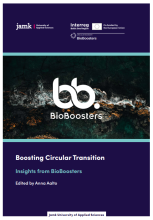
Boosting circular transition: Insights from BioBoosters

Boosting Circular Transition - Insights from BioBoosters. Edited by Anna Aalto -  Jamk University of Applied Sciences – Interreg Baltic Sea Region, co-funded by the European Union – Circular economy Bioboosters.
Type
Author
Anna Aalto, Jamk University of Applied Sciences, Finland
Laurynas Braškus, Sunrise Tech Park, Lithuania
Svea Uusen, Pärnu County Development Centre, Estonia
Lina Stanionytė, Sunrise Tech Park, Lithuania
Artur Sobolewski, PRO CIVIS Foundation, Poland
Magnus Persson, Paper Province, Sweden
Eva Fridman, BioFuel Region, Sweden
Malin Hildén, Paper Province, Sweden
Katrin Kepp, Estonian University of Life Sciences, Estonia
Inguna Kucina, Vidzeme Planning Region, Latvia
Gudrun Mernitz, WITENO GmbH, Germany
Małgorzata Olesiak, PRO CIVIS Foundation, Poland
Per Myhrén, Paper Province, Sweden
Publication Date
11/2025
Country
Finland
Language for original content
Scope

The BioBoosters hackathon model has brought together innovators who have come up with workable solutions for a wide range of challenges in the bioeconomy sector. The programme is coming to an end, and this report sets out how the project connected regional innovation systems across the Baltic Sea Region to a joint open innovation platform tackling business-driven circular transition challenges.

It explores the relevance, efficiency, impact and sustainability of the hackathon model and the inter-regional cooperation dimension.

The analysis is based on data and feedback from 18 challenge provider companies, nearly 100 mentored teams and over 500 connected industry and research specialists. It looks at what makes this hackathon model impactful and the added value of an international network.

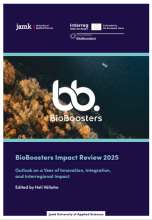
BioBoosters Impact Review 2025 : Outlook on a Year of Innovation, Integration, and Interregional Impact. Edited by Heli Väliaho -  Jamk University of Applied Sciences – Interreg Baltic Sea Region, co-funded by the European Union – Circular economy Bioboosters.
Type
Author
Anna Aalto, Jamk University of Applied Sciences, Finland
Eva Fridman, BioFuel Region, Sweden
Heli Väliaho, Jamk University of Applied Sciences, Finland
Anna Gajek, PRO CIVIS Foundation, Poland
Malin Hildén, Paper Province, Sweden
Anni Hintikka, Jamk University of Applied Sciences, Finland
Lili Veesaar, Estonian University of Life Sciences, Estonia
Lina Stanionyte, Sunrise Tech Park, Lithuania
Svea Uusen, Pärnu County Development Centre, Estonia
Matti Räsänen, Jamk University of Applied Sciences
Magnus Persson, Paper Province, Sweden
Marta Riekstina, Vidzeme Planning Region, Latvia
Ida Norberg, BioFuel Region, Sweden
Rimas Meištininkas, UAB Toksika, Lithuania
Per Myhrén, Paper Province, Sweden
Damian Kuznowicz, PRO CIVIS Foundation, Poland
Inguna Kucina, Vidzeme Planning Region, Latvia
Katrin Kepp, Estonian University of Life Sciences, Estonia
Moa Jonsson, BioFuel Region, Sweden
Gudrun Mernitz, Witeno GmbH, Germany

Publication Date
11/2025
Country
Finland
Language for original content
Scope

BioBoosters is a bioeconomy business accelerator. It runs a business-driven hackathon concept to boost the circular transition of the bioeconomy sector. 

The hackathon concept is simple: identify a problem and bring innovators around the table to find a solution. For instance, hemp production in Estonia is flourishing – but the company growing it had no viable use for the stalks. The innovators explored options such as hemp-based filament for 3D printing, hemp as a substrate for mushroom cultivation for biodegradable packaging and extracting enzymes from hemp via fermentation-based processes.

This report covers another eight hackathons, tackling logistics, wood, activated carbon, wine corks, soil health and apples. 

The Horizon Europe RECREATE (REcycling technologies for Circular REuse and remanufacturing of fiber-reinforced composite mATErials) project aims to develop a set of innovative technologies which will exploit the potential of end-of-life complex composite waste. 

It is organising a webinar looking at practical and emerging approaches for recovering value from end-of-life composite parts.

RE-PLAN CITY LIFE - Shaping circular cities
Type of organisation or company
Country
EU
Language for original content
Scope

The RE-PLAN CITY LIFE project aims to raise awareness about the circular economy potential of materials, products and applications obtained from tyre recycling and encourage the uptake of environmentally-friendly behaviour and practice in urban communities.

Its platform includes a community and marketplace for exchanging practical information about recycled tyre materials and a calculator for assessing the circularity and environmental impact of products.

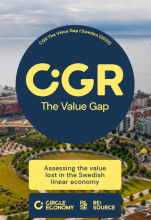
CGR The Value Gap:  Sweden – Assessing the value lost in the Swedish linear economy – Circle Economy, RISE, RE-SOURCE
Type
Author
Carl Jensen (RISE), Andrew Keys (Circle Economy), Julie Lebreton (Circle Economy), Ann-Charlotte Mellquist (RISE), Megan Murdie (Circle Economy), Marc de Wit (Circle Economy), Peter Stigson (RISE)
Publication Date
11/2025
Country
Netherlands
Language for original content
Scope

This report explores the links between circularity and economic value, offering a new perspective on how linear practices lead to economic inefficiencies.

CGR has built up a huge body of data by mapping material flows, and this report uses that as a basis to look further and ask about the economic value of the materials we use, the products we consume and the systems we build—and where value is lost or not created.

Current economic models leave substantial value untapped: resources are over-extracted, materials wasted, products underused, and social and economic opportunities missed. The report looks at value creation and loss in mining & extraction, manufacturing, agrifood, construction, mobility and consumables. It also explores the circular potential in each sector.

European Commission logo
News type
Sector
Scope

The Commission is holding a public consultation on how to improve EU product legislation, specifically regarding the circular economy and the digital transition. It relates to the revision of the New Legislative Framework: established in 2008, it provides a blueprint for product harmonisation legislation, aligning 30 EU legal acts. 

Deadline: 4 February!

The new SOLRESS project will be working on developing safer, sustainable and high-performance bio-based solvents for European industries, using organic waste as a feedstock. 

Subscribe to