Bio-based plastics are wholly or partly derived from biomass and so help reduce reliance on fossil fuel-based plastics.
Feedstocks include primary and secondary sources. Agricultural and forestry residues and post-consumption organic waste have lower environmental impacts than primary feedstock but collection and transportation issues make scaling up a challenge.
As a whole, the sector is struggling to achieve real scale: bio-based plastics account for only 0.5% of global plastics production and are projected to reach 1% by 2030.
Scaling is hampered by feedstock sustainability, competitiveness, technological maturity and cost: currently, producing bio-plastic is generally 1.5 to 2 times more expensive than conventional plastics.
This briefing presents key air pollutant trends and projections for energy-intensive industries in Europe.
It looks at how greenhouse gas emissions have fallen over the past two decades, but improvements in this area have stalled in the last ten years. Further progress will require the implementation of environmental legislation and transformative change in emission-intensive processes.
The briefing also looks at decarbonisation and circularity. Both approaches, particularly electrification, offer significant co-benefits for pollution prevention. A clear understanding of these co-benefits and risks should be used to guide investments and maximise environmental, health and competitiveness gains.
Applications are now open to host EU Green Week 2026 partner events! Organisations interested in hosting a partner event are invited to apply by 20 March.
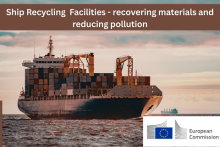
Ship recycling plays a key role in advancing the circular economy - after all, ships do contain large amounts of high-quality steel and other valuable materials.
The European Commission has just adopted the 15th edition of the European List of Ship Recycling Facilities: read about what this means!
The EU Circular Economy Resource Centre (EU CERC) has published a call for tenders intended to prepare policymakers and the private sector in EU CERC partner countries for the EU Ecodesign for Sustainable Products Regulation. Read all about it!
Global Gateway is the EU's strategy to boost smart, clean and secure connections in digital, energy and transport sectors, and to strengthen health, education and research systems across the world.
This session will explore how to promote innovative technologies, business models and strategies for scaling up Global Gateway investments in the circular economy, including waste management, in the Latin American and Caribbean region.
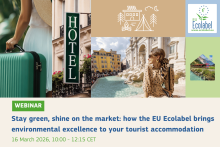
This webinar will explain how the EU Ecolabel for tourist accommodation services guarantees environmental excellence, enhances visibility to consumers and guarantees compliance with new and forthcoming EU legislation on sustainability labels.
Find out how it can make these services more competitive!
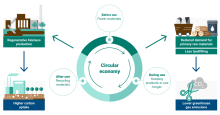
This briefing from the European Environment Agency looks at the links between the circular economy and climate change mitigation. Many reports and studies argue that this link exists, but estimates of its potential diverge greatly. See what the EEA has to say about why that is!
This report proposes a bold new idea for EU waste policy: an EU-wide cap-and-trade system to cut residual municipal waste – the waste that remains after prevention, reuse and recycling.
Instead of pushing waste from landfill to incineration, the proposed scheme would put a binding limit on total residuals, creating a strong incentive for waste prevention, reuse, refill and high-quality recycling.
The report also explains why major mineral and combustion wastes should be treated separately, and outlines how a fair, per-capita system could work in practice across the Member States, supported by robust monitoring and verification.
The FertiCovery project focuses on nutrient recovery and the production of fertilisers from biowaste, manure and wastewater.
This workshop will look at the upscaling potential of the 25 technologies assessed by the project and examine the regulatory frameworks governing them, including barriers and enablers.