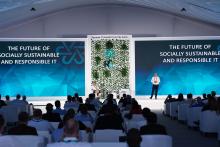
The Sustainable IT Summit took place on 23 April in the United Arab Emirates, organised by Circular Computing which, unsurprisingly, is endeavouring to promote circularity in the IT sector. The summit was attended by IT industry leaders who discussed sustainability challenges in this sector and the opportunities offered by circular processes such as remanufacturing.
The general consensus was that remanufacturing and acceptance of reused devices is inevitable: 20% of enterprise laptops bought will be pre-used in a few years.
Sustainable Estimatics is a carbon tracking tool, intended to help the insurance industry manage new environmental, social and governance (ESG) regulations and become greener and less wasteful.
It empowers insurers to quantify and mitigate the carbon dioxide equivalent emissions associated with their entire car insurance claims process. As regards the circular dimension, it enables insurers to compare the environmental impact of repairing car parts versus replacing them.
The Circular Investment Readiness Network is a joint initiative by the Horizon Europe projects CircularInvest and DEFINITE-CCRI.
The initiative will help circular economy projects overcome the challenges related todevelopment and investment readiness. It will bring local governments, investors, Project Development Assistance providers and external service providers together with CircularInvest and DEFINITE-CCRI project owners and SMEs to foster the exchange of expertise, pinpoint opportunities and generate momentum.
Basically, it will advance circular economy objectives by facilitating the development of financeable, high-impact, low-risk circular projects.
By registering, you will be part of the network mailing list and invited to all future information sessions.
The Plastics Technology Centre AIMPLAS continued to increase its activity on the circular economy. In 2023, it presented 206 projects on the subject, provided more than 1100 technological services to companies and participated in 76 training and conference activities.
This redoubled activity went hand in hand with an increase in people and facilities carried out based on environmental sustainability criteria in conjunction with an emissions reduction plan that enabled the Centre to obtain the REDUZCO seal from the relevant Spanish Ministry.
The 6th Refill & Reuse Trade Fair will take place on 13-14 May in Paris, in the heart of the Parc Floral. It's an opportunity to find out about the world of refill and reuse and to learn more through masterclasses, conferences and discussions with over 75 speakers from various sectors.
InvestCEC, working with the DEFINITE-CCRI project as part of the CCRI initiative, is hosting a webinar on "Empowering entrepreneurs for investment success". It will take place on 11 April and aims to enable entrepreneurs to overcome funding challenges and attract investments in the circular economy.
This is an official side event of the World Circular Economy Forum.
Ms Ettinger is a lawyer in Germany and holds a Master of Law degree from George Mason University (USA). Before joining EuRIC, she worked at a Brussels-based consultancy, advising multinational companies on environmental, health and safety matters.
EuRIC is a confederation which represents the interests of European recycling industries within the EU. It spans the majority of waste streams, and so can facilitate cooperation between national recycling and resource management federations and companies from over 23 European countries, operating both locally and globally.
EuRIC represents:
5 500+ companies generating an aggregated annual turnover of about €95 billion, including large companies and SMEs involved in the recycling of and trade in various resource streams
300 000 local jobs which cannot be outsourced to non-EU countries
a million tons of waste recycled each year (metals, paper, glass, plastics, WEEE, ELVs, tyres, textiles, construction & demolition, etc.).
By turning waste into resources, recycling loops recycled materials back into value chains. Recyclers play a key role in bridging resource efficiency, climate change policy and the industrial transition.
Go Circular 2024 will focus on utilising enablers and breaking barriers to achieve plastic circularity.
It's an opportunity to discuss the main challenges in the field of plastic circularity and to identify partners for related projects. The conference covers the entire circular plastic value chain and aims to speed up the shift to a low carbon circular economy.
Businesses need financing, and banks need to know whether a given company is a good risk. The Risk project group (part of De Nederlandsche Bank's Circular Economy Working Group and consisting of experts from Rabobank, ABN AMRO, ING, Triodos and Invest-NL) set out to create a scorecard which would enable financial institutions to establish whether a specifically circular business is a good bet.
Enterprise Europe Network Flanders, Flanders, Wallonie Entreprendre and Hub.Brussels are organising an official WCEF2024 side-event: a global online matchmaking session focusing on circular innovation. There'll be an online part (8-14 April) and an in-person part (17 April).