This training, scheduled to take place on 24 January at 9:00-13:00 CET on ZOOM platform, aims to present the tools and methodology developed by the Up2Circ team to support SMEs with the uptake of circular innovation.
Circular Hub Tirol is the point of contact for all issues dealing with thecircular economy in Austria's Tyrol region. Together with their partners, they offer services such as
project initiation
networking
circularity check for SMEs
information and further education on the circular economy, and
an annual exhibition of good practices in the area of circular design.
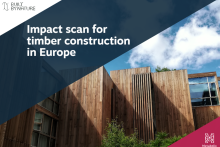
At European level, the built environment is responsible for 40% of CO2-eq emissions and roughly 60% of material consumption.
By applying bio-based alternatives to conventional ‘mineral’ construction materials, the environmental impact of the EU27+UK sector can be reduced by 18%.
However, there is a limit to the sustainable wood supply that can be harvested without compromising vital functions provided by forests, and the projected increase in wood consumption is not compatible with the realistic growth potential of harvesting activities. Therefore resource efficiency, bio-based added value or demand for new housing should be carefully weighted in to ensure a sustainable shift, the study concludes.
Gravity Wave is a social start-up based in Spain. It focuses on working with small-scale fishermen to collect as much as possible of the plastic waste fouling the Mediterranean, from water bottles to a whole load of discarded fishing nets.
Knof is a Slovenian social enterprise with a focus on circularity and sustainability. It operates reuse boutiques, a circular laboratory and a programme for individuals and entrepreneurs supporting sustainable companies.
The Circular Economy Lab was set up in 2018 by Cariplo Factoryand Intesa Sanpaolo Innovation Center. It is a hub of circular economy competences that aims to help spread the principles and methods of the circular economy and support companies as they go circular.
The Lab is involved in various projects, such as the Iren Startup Award Call4Circular | Circular products and materials. It promotes the circular economy by holding workshops on key topics and by creating networking opportunities for innovative ecosystem players, such as startups, innovative SMEs, universities, research centres and technology transfer centres.
At the Handelsblatt Circular Economy conference, the central role of industry, business, politics and science in implementing the circular economy will be discussed under the motto "reverse thinking".
The conference brings together top thinkers, decision makers and experts who already have experience in implementing circular economy solutions.
The Ellen MacArthur Foundation is a UK charity which aims to speed up the transition to the circular economy. Since it was set up, the charity has emerged as a global thought leader, putting the circular economy on the agenda of decision makers across business, government and academia.
The Ellen MacArthur Foundation is a UK charity which aims to speed up the transition to the circular economy. Since it was set up, the charity has emerged as a global thought leader, putting the circular economy on the agenda of decision makers across business, government and academia.
Carsten Wachholz joined the Foundation in 2020 after spending two years working for the European Investment Bank on Corporate Responsibility and another four years working for the European Environmental Bureau on the first EU Circular Economy Action Plan. Carsten leads the Foundation's newly established Brussels-based team supporting the development of circular economy policies at EU and international level (e.g. G20, OECD), in close collaboration with the Foundation's systemic initiatives on plastics, fashion and food.
Four-day long celebration of the circular economy in Dublin running from 29 May to 1 June 2023. A unique gathering of international experts, industry leaders and forward-thinking individuals, dedicated to advancing the circular economy agenda.