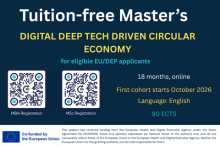
3D-CIRCULAR is building degrees to train professionals to understand material flows and governance and work with the data infrastructure, AI and traceability systems.
The project will run until July 2029, and three master's degrees are already available. The first intake will start in October 2026; apply by 25 September!
High-quality learning content providers from across Europe are invited to join an EU-wide education and training ecosystem supporting Europe's green and digital industrial transformation.
The circular economy and recycling systems are among the priority areas. Selected participants will be eligible for financial support to adapt, digitise or scale content.
SYNCRETIX assists organisations with designing and implementing ESG transformation, circular economy solutions and resilience strategies.
Their approach integrates circular economy principles across the entire lifecycle of products, buildings and urban systems while strengthening climate resilience, resource efficiency and long-term sustainability.
Climate change, inconsistent policies, greenwashing concerns and the promise of AI-powered sorting systems are reshaping how the wood sector must adapt.
The Wood2Wood project is addressing a structural blind spot in circular economy transitions: the future occupations needed to make wood reuse viable at scale.
The Growing Regenerative Futures acceleration programme supports people who want to build, transform or grow projects connected to the circular economy in the food and agriculture sectors.
The circular economy will not be built on materials alone — it needs people, and the right skills, in the right places. Europe's green transition is creating jobs. But it is also creating gaps — in skills, in access and in who benefits.
Four speakers from research, industry, academia and policy will tackle the questions that matter — from what is actually working on the ground to whether Europe can get there by 2030, and get there fairly.
The Panel will advise the European Commission on current skills needs in Science, Technology, Engineering and Mathematics sectors, as well as on innovative Science, Technology, Engineering, Arts and Mathematics approaches that can support skills development.
GO Circular is a professional training programme designed for organisations and professionals seeking to integrate circular economy principles into their business strategy.