Specialists, companies and key stakeholders from the packaging value chain will address the challenges and opportunities posed by the transition toward more sustainable models and explore the latest trends in barrier packaging materials and solutions.
This webinar will look at how the EU Ecodesign for Sustainable Products Regulation (ESPR) is affecting Indian textile and fashion suppliers exporting to the EU. It will explain what is involved and what exporters need to do to comply with the rules.
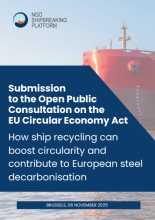
With a significant number of ships expected to reach the end of their service life shortly, ship recycling presents a strategic opportunity for Europe. Boosting domestic ship recycling will:
secure a steady supply of secondary raw materials and so strengthen Europe’s industrial resilience and strategic autonomy;
make a meaningful contribution to the decarbonisation of the EU steel and construction sectors, supporting Europe’s broader climate and circular economy goals;
create green jobs in the recycling and waste management sector;
align with EU environmental policies preventing the export of hazardous materials and restrict exports of waste that harm the environment and human health in third countries.
Circul'R believes that it is vital to unite regulation, innovation and cooperation if circularity is to drive competitiveness and sovereignty. It feels that it is a mistake to prioritise recycling over circular business models, such as repair and reuse.
It therefore recommends:
supporting circular business models by making them more competitive and boosting market access and financing,
setting an EU target for reducing the material footprint, involving reducing consumption and coming up with more reliable and comprehensive indicators,
changing the tax environment, including incentives for circular solutions and disincentives for linear ones, establishing European standards on repairability and binding circular targets and models of circular-oriented public procurement.
This joint statement is a collaborative effort by the Cambridge Institute for Sustainability Leadership, Ellen MacArthur Foundation, Environmental Coalition on Standards, European Environmental Bureau, Institute for European Environmental Policy, Reuse and Recycling European Union Social Enterprises (RREUSE) and Zero Waste Europe.
It calls for the Act to embed circular economy principles into Europe’s entire economic system. It underscores the urgent need for robust legislation that can accelerate the transition and secure the EU's leadership in the global circular economy.
Key points:
Set science-based targets on resource use
Harness the potential of keeping products and components in use, not just materials
Accelerate safe material circulation by integrating chemical and circular legislation.
A number of ECESP Coordination Group members have published their contributions to the call for evidence on the Circular Economy Act. The Group covers a wide spectrum of interests, and this necessarily influences their views on what should be included in the CEA and just how the Act should drive on the circular economy. Have a look!
Drawing on more than 30 years' experience, lessons learned from EU-funded projects and the expertise of local and regional authorities across Europe, ACR+ is sharing its recommendations for the Circular Economy Act.
This position paper outlines 26 recommendations to strengthen the EU’s circular transition, focusing on:
Establish a Circular Single Market with binding targets to increase circular material use and reduce residual waste;
Leverage public procurement to drive demand for sustainable and circular products;
Reinforce EPR to support prevention, repair and reuse;
Tackle WEEE through stronger collection, treatment and recovery of critical raw materials;
Create a more circular built environment via sustainable (de)construction practices;
Building on challenges and best practices identified among frontrunner cities and regions, ICLEI Europe and its members have provided nine policy recommendations to address the limitations of the current scope of the CEA:
Leverage circular economy to cut consumption-based emissions
Reduce material consumption to enhance the EU’s economic security
Ensure the transition to a circular economy is just and inclusive, leaving no one behind
Ensure a multilevel governance approach in policy development and implementation
Shift funding from piloting towards scaling-up
Build capacity in cities to support circular economy implementation
Build the case to reform the linear tax system
Leverage public procurement to provide a launch market for circular businesses
GCE welcomes theCircular Economy Act initiative as a very important step forward in enhancing the circular economy in the EU. It highlights the need to rethink the current economic system in order to secure intergenerational and resource justice, uphold planetary boundaries and ultimately ensure the resilience and security of the EU.
However, incentivising the market for secondary materials will not suffice, and additional actions are needed:
recycling is not enough: reusing and remanufacturing must be prioritised;
steps must be taken to address overconsumption and overproduction;
harmonised end-of-waste criteria, a systemic shift in business model, appropriate waste collection and the promotion of reuse and repair are particularly necessary in the textiles and electronics sectors.
In this position paper, FEAD offers its input for the Circular Economy Act consultation.
It supports a CEA that turns circularity into a core competitiveness strategy for Europe by:
creating a predictable, integrated single market for recycled materials;
activating strong, durable demand for recycled materials;
aligning fiscal and financial tools with circular outcomes;
strengthening governance, enforcement and administrative capacity so rules deliver in practice.
It proposes a binding target of 25% by 2030 for the Circular Material Use Rate. It argues that recycling and recovery must become industrial-scale resource streams, and that robust recovery and final treatment systems for residual waste are key for safeguarding system resilience and environmental protection.