The Horizon Europe POLYMEER project aims to establish a sustainable bio-based value chain for bioplastic products. By efficiently converting wet brewers’ spent grain into high added value materials, it is endeavouring to diversify the array of innovative material solutions capable of replacing traditional plastics.
The 29th ReNess Conference on Shaping the Transformation – Instruments and Levers for the Implementation of a Competitive Circular Economy will focus on the macroeconomic potential of the circular economy.
Are you involved in public procurement of innovative goods and services? This webinar will set out the findings of two projects (BRINC and P5Innobroker) focusing on this area.
You will hear feedback from the two projects and learn about an open access toolkit.
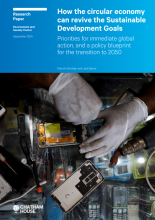
With progress on the UN’s Sustainable Development Goals (SDGs) badly off track, solutions are needed - and the circular economy has clear potential.
This Chatham House paper explores how the circular economy could support each of the 17 SDGs and argues for this concept to be put at the heart of emerging plans to drive sustainable development towards 2050.
It identifies five priorities for action: embedding principles of justice and inclusivity into the circular transition; increasing international policy coordination; reforming the financial architecture to ensure the circular economy gets the investment it needs; rewiring the global system of trade to make it easier to trade circular products and services; and developing common standards and metrics.
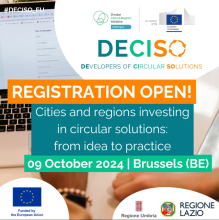
DECISO (DEvelopers of CIrcular SOlutions) is a Horizon Europe project running from 2023 to 2025 which will assist European cities and regions with developing financing schemes for circular economy initiatives. This year, its annual conference will focus on Cities and regions investing in circular solutions: from idea to practice.
The I AM CIRCULAR challenge is your opportunity to showcase your innovations and lead the charge in the circular economy. This is not just a competition: it's a celebration of transformative ideas that are reshaping our world. Apply by 15 November!
The 2024 ASEAN Circular Economy Forum (ACEF2024) will focus on Guiding the Transition – ASEAN and EU Approaches to Circular Innovation and Entrepreneurship.
The Forum aims to support innovation and entrepreneurship for a circular transition, showcase existing circular economy practices in the ASEAN region and build on ASEAN's traditions and values for a circular transition.
ETRA, the European Tyre Recycling Association, and AIMPLAS, the Plastics Technology Centre, are organising an international workshop exploring rubber recycling, polymer technology and EU-funded projects.
It will address various challenges in the elastomeric materials sector by providing a dynamic platform for sharing knowledge and exploring opportunities. There will be a pitch session, where experts will consider each participant's project, and sessions on issues such as Market analysis: challenges, opportunities and limits in the recycled rubber industry.
The transition towards a circular bioeconomy is crucial for meeting the goals of the European Green Deal and the Circular Economy Action Plan and for tackling the climate and biodiversity crises.
Following on from COP16 on Biological Diversity and on the same day that delegates will be discussing nature and biodiversity at COP29 on Climate Change in Azerbaijan, the ECESP Leadership Group on Circular Bioeconomy invites you to join the #EUCircularTalks on Circular Bioeconomy Transformation Methodologies.
On 5 September, ZeroW will be holding a workshop bringing together a diverse group of stakeholders, research institutions, startups, industry associations, regulatory authorities and more. They will discuss how to market innovative food loss and waste solutions produced during the research and development stage of EU projects.