CircularTracker is an online circularity measurement tool. It enables businesses and institutions to assess, visualise, compare and communicate product circularity features in a standardised way.
Closing the green skills gap is crucial to enabling a circular economy. Circle Academy is a gamified e-learning platform that boosts mass adoption of these skills.
The CEE2ACT e-learning platform supports (circular) bioeconomy capacity-building in Central and Eastern Europe. It offers four interactive training modules tailored to different audiences. Available in 11 languages, it includes exercises, resources, an Open Forum and expert support to boost knowledge and action.
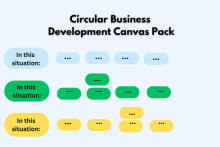
The Circular Business Development Canvas Pack is a set of tools designed to help businesses transition to circular economy models. It integrates key sustainability principles into business development, offering structured frameworks to map out circular strategies, value chains and impact.
This article identifies sustainable practices that are intended to reduce food loss and waste from the value chain, highlights the importance of sustainability accounting and reporting during each stage of food preparation, production and consumption and advances a theoretical model that clearly summarises different aspects related to environmental, social and governance dimensions.
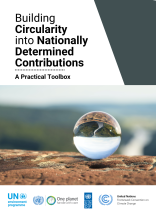
UNEP’s One Planet Network, the UNDP and the UN Climate Change secretariat have developed a practical toolbox that will help countries identify, prioritise, implement and track circular economy measures with a view to implementing their Nationally Determined Contributions (NDCs) and making them more ambitious.
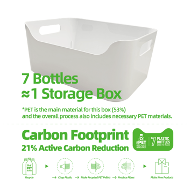
Energy Expert, an Alibaba Cloud company, uses carbon footprint accounting combined with digital technologies to track the CO2 performance of a new range of products, from the initial plastic waste to the final rPET product, and makes the information available to the consumer.
The Corporate Sustainability Reporting Directive (CSRD) will require EU business to report on several new sustainability topics, including their circular economy performance. However, only 2% of businesses currently comply with the disclosure requirements on resource use and the circular economy. Is your organisation ready?
This revised monitoring framework measures progress towards the circular economy considering the interlinkages between circularity and the EU’s climate neutrality goal, the zero-pollution ambition for a healthier and fairer planet, competitiveness, sustainability and securing materials supply.
The BUS-GoCircular project aimed to foster a green energy workforce in the construction sector. It was funded by the EU’s Horizon 2020 Research and Innovation Programme, and ran from September 2021 to March 2024.
The project produced a huge amount of training materials, such as the Train the Trainers’ programme guide. All of them can be consulted on the project home page.