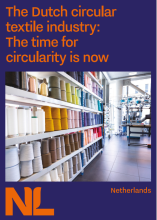
This publication featuring Holland Circular Hotspot shows the state of play and potential of circularity within the textile value chain in the Netherlands and beyond.
It aims to engage international dialogue on accelerating the transition to a fully circular textile economy, with policymakers, researchers, entrepreneurs, consumers and investors.
The challenges of achieving sustainability and circularity in textiles are complex and interconnected, from reducing environmental impact to improving labour conditions. This underscores the importance of international and multi-stakeholder collaboration to drive innovation, scale up sustainable practices and create a thriving circular textile industry.
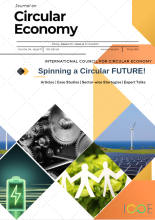
The Journal on Circular Economy is an initiative by the International Council for Circular Economy (ICCE). The journal explores various dimensions of the circular economy, including policy frameworks that support sustainable practices, research initiatives that drive innovation, and collaborative efforts that foster knowledge sharing among stakeholders.
The January 2025 edition features an article by Freek van Eijk from Holland Circular Hotspot, one of the ECESP Coordination Group co-chairs. The article focuses on the Netherlands: embracing circular economy as a business opportunity and a necessity. It looks at the origin and future of circular economy developments there and what lessons might be learned for India.
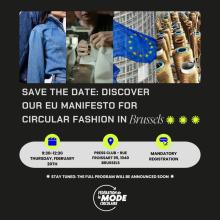
The Fédération de la Mode Circulaire (Circular Fashion Federation) is organising an event which will mark a milestone in their journey towards sustainable fashion: the release of their EU Manifesto for Circular Fashion. This manifesto outlines a policy roadmap for the European Union to leverage circular fashion as a means to bolster its textile industry, promote fair competition and champion environmental and human rights standards.
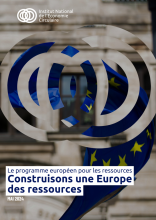
INEC, a leading think tank on issues related to the preservation of natural resources, has published its European Resource Programme.
It defines ways to preserve natural resources, focusing on six resources that will be crucial for energy, the economy and the environment: water, wood, li-ion batteries, permanent magnets, copper and building materials.
The Circular Economy package has merely resulted in measures targeting consumers rather than authorities. Positive initiatives such as the digital product passport aside, this vision of the circular economy is not sufficiently integrated into decarbonisation goals. INEC's realistic measures, the result of broad debate between stakeholders, aim to transform the economy and make it genuinely circular.
The 2025 Basque Circular Summit will be the largest event on the circular economy in southern Europe this year. It will analyse the challenges and opportunities posed by the circular economy for companies, society and the economy in the Basque Country and show what has already been achieved.
This publication contains the results of over 74 projects completed as part of the Circular Ecoinnovation Programme between 2017 and 2023. The programme, managed by Ihobe, the environmental management agency of the Basque Government’s Ministry for Economic Development, Sustainability and the Environment, drives ecodesign, circular economy demonstration and strategic ecoinnovation in Basque companies.
The market, commercial, economic, technical or environmental feasibility of each project has been graphically included in each datasheet.
See also the website listing all the Basque Country's circular solutions to date.
Threads of Change is a new platform created by Humana People to People that highlights the transformative role of the second-hand clothing (SHC) industry in fostering sustainability, economic growth and social equity.
This initiative calls for supporting policies with a holistic perspective for a sector that is key to reducing environmental impact, creates green jobs along the global value chain, and contributes greatly to the EU’s GDP while minimising the use of scarce resources.
The platform's main aim is to spotlight the SHC industry's critical role in shaping a more sustainable textile sector. Help us build a case for an even more efficient and ambitious textile value chain by sharing your best practices or your views on the topic!
SustainableSolutionsMatch is the first cross-sectoral virtual event empowering European businesses on their path to a sustainable and circular economy. It brings solution seekers and providers together to tackle real challenges and find practical answers.
Whether you're looking for innovative ideas or reliable partners, this event brings solution seekers and providers together to tackle real challenges and find practical answers.
Le Marché is based in Pakistan and active throughout South Asia, with partners in Germany, France, the UK and the US. It has a two-pronged approach: it collects textile waste and recycles it for use as a secondary raw material, and it uses fibres made from agricultural waste.
Achieving climate neutrality requires addressing Scope 3 emissions, which encompass supply chain and financed emissions and account for approximately 97% of global emissions. Tackling these emissions is central to global efforts to transition to a circular economy and meet the ambitions of international climate commitments.
The UK-based company RedGirraffe ESG Horizon has a solution for this problem.