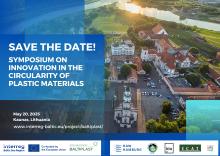
This conference will present papers by young scientists, PhD students, students and scientific groups on new technological and IT solutions and innovative products and materials supporting sustainable (including circular) and competitive development.
Representatives of science, industry and start-ups will also promote implemented projects, innovative product solutions and innovations in the business process.
Are you passionate about sustainability, innovation and tackling the challenges of plastic waste? The Symposium on Innovation in the Circularity of Plastic Materials is your opportunity to contribute to shaping the future of plastic materials.
The Basque Country feels very strongly about the circular economy. One initiative they've adopted to promote it is the Zirkularrak website promoting locally made circular products.
This CEPS In-Depth Analysis examines the role, state of play and future prospects of standardisation of critical raw materials (CRM) from an EU perspective.
It begins with an overview of the key benefits and actors in both the EU and global technical standardisation system.
It then maps key recent developments and initiatives in CRM standardisation, in the EU and globally. Drawing on consultations with experts, it identifies three fundamental risks and challenges: the limited participation of EU stakeholders and experts, specific content gaps in recycling and traceability, and a highly fragmented ESG standardisation landscape.
Lastly, it provides policy recommendations to help address these challenges and enhance the EU’s role in CRM standardisation.
This report is the outcome of a collaborative endeavour by IFC, the Romanian Government, PIVOT-C and FEPRA GROUP.
A year of in-depth consultations and workshops (2023-2024) involving Romanian experts from the public and private sectors resulted in a guide setting out operational actions and recommendations for Romania's circular economy transition. The recommendations are intended for the Romanian government and central authorities and aim to facilitate the implementation of the National Circular Economy Strategy and the Circular Economy Action Plan launched in 2023.
The proposals cover regulatory frameworks, financial incentives, educational initiatives and infrastructure development.
The ERASMUS+ CIRCVET project on Circular economy practical training materials for plastics manufacturing industries is organising a workshop on Closing the Loop: Circular Packaging and Company Study Cases.
The workshop will present the project and the e-learning platform and share interesting corporate case studies.
The World Circular Economy Forum is one of the biggest circular events of the year. WCEF2025 will take place in São Paulo, Brazil on 13-16 May under the heading Tropical solutions for sustainable growth!
The programme has now been released, with a rich selection of plenaries and parallel sessions.
The topic this year is Circular solutions for a competitive EU.
On 3-4 June, the conference will feature high-level debates on policy aspects of circular economy. On 5 June, in-depth discussions among stakeholders will focus on unleashing the circular economy’s potential for a competitive and resource-efficient Europe.
This year, the European Roundtable on Sustainable Consumption and Production will focus on Multi-stakeholder cooperation on sustainability: Role of business, academia, public sector and civil society in Sustainable Consumption and Production.
Re:inventex is carrying out a project for the recycling of post-industrial and pre-consumer textile waste. It is essentially the first pilot project in Ukraine to create a modern infrastructure for the collection, sorting and recycling of textile waste.