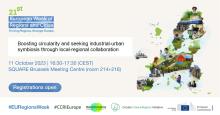
On 11 October 2023 in Brussels, the Circular Cities and Regions Initiative (CCRI) and the Hubs4Circularity (H4C) will host an onsite session during the European Week of Regions and Cities.
The session will focus on industrial symbiosis and circular value chains.
More information on the CCRI is available at the dedicated stand.
The new Horizon Europe Cluster 6 calls for proposals related to the circular economy will be open for submissions until 22 February 2024. EUR 120 million will be available in the form of grants to cover safe, integrated circular solutions at regional and sectoral levels for important material flows and product value chains.
DiCE (Digital Health in the Circular Economy) has been created to bring key stakeholders together to address challenges associated with the growing use of digital healthcare products and increasing demand for raw materials to manufacture new electronic devices and other equipment.
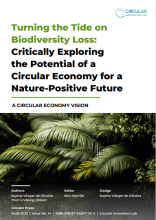
Global biodiversity is being lost at an unprecedented rate, giving rise to a sixth mass extinction and constituting one of the core challenges of the triple planetary crisis. Biodiversity forms the foundation of life on Earth and its loss presents a systemic risk to future human survival. To reverse the biodiversity crisis, transformative systems-wide change is required.
This paper addresses an existing research gap by exploring whether the circular economy can play a role not only in halting biodiversity loss but also in regenerating it and thereby contributing to a nature-positive future. To unlock the regenerative potential of the circular economy, a coherent strategy is needed that provides incentives for all actors, notably policymakers and businesses.
This Sitra memorandum focuses on providing building blocks to help the next European Commission address the ecological crisis while maintaining Europe's competitiveness and resilience.
The renewed European Commission will take office in 2024 and must keep up the European Green Deal, ensuring that it centres on nature and mainstreams the circular economy across the EU single market.
The key recommendations include:
ecosystem accounting
biodiversity offsets
circular single market
leveraging nature as a business opportunity
using data for the green transition
addressing Europe's global biodiversity footprint, and
reforming the common agricultural policy.
Stakeholders are encouraged to contribute to the ongoing debate, ensuring the strategy's success.
The conference on Green PLM 2023 - We enable the shift to sustainability will feature presentations and discussions on data management and digital solutions for product carbon footprints, secondary material rates and circularity.
There is a fee to take part in this conference, which will be held in Berlin on 9 November 2023. The event will be partly in German and partly in English.
This online meeting on 18 September 2023 will discuss which further recycled nutrient products might be appropriate for certified Organic Farming, based on practical examples, and under what conditions they might be considered.
Questions considered: solubility and plant availability of nutrients, origin of raw materials, chemicals used in recovery process and life cycle assessment, contaminants and safety.
Examples will be: calcined phosphates, biochars, phosphate fertilisers from ashes, recovered ammonium sulphate, recovered nutrients from aquaculture and other marine wastes.
Gravity Wave is a social start-up based in Spain. It focuses on working with small-scale fishermen to collect as much as possible of the plastic waste fouling the Mediterranean, from water bottles to a whole load of discarded fishing nets.
ICLEI Europe and the City of Lisbon (Portugal) are proud to announce that the 11th Procura+ Conference will be held in the Portuguese capital on 13 and 14 March 2024.
The conference will showcase how cities and public authorities can use public procurement to implement step changes that make a big impact.
Re-think Circular Economy Forum is an event designed to present a vision on macro-trends, possible evolutionary paths, and main projects concerning the Circular Economy on a local, national and international level. It wants to encourage the development of Circular Economy in Taranto and in the rest of Apulia territory.