On 21 November 2024, Circular Wien is organising an upcycling fashion show featuring slow fashion designers aimed at reducing textile waste, an exhibition of art and jewelry made from recycled materials, and food rescued from waste.
Concrete accounts for 8% of the world's CO2 emissions. Efforts are being made to reduce its embodied carbon, but reusing concrete from existing buildings has significant untapped potential.
This study presents an innovative digital workflow for predicting the lifespan of concrete elements, CO2 uptake via natural carbonation and embodied carbon savings through reuse. The workflow was tested in a building from the 1960s with high reuse potential.
It found that most precast elements would last long enough to be reused effectively and that reuse is better for the environment than carbonation.
The digital workflow is useful for quickly assessing lifespan, carbonation and embodied carbon of concrete. It is a useful tool when designing for reuse.
BUILD UP, the European portal for energy efficiency and renewable energy in buildings, is hosting the fifth in a series of six webinars organised with the CircularB COST Action project. This one is on Contractors, Builders and Manufacturers of Construction Products.
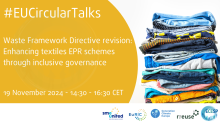
The ECESP Leadership Group on Textiles organised the #EUCircularTalks event on the revision of the Waste Framework Directive: Enhancing textiles EPR schemes through inclusive governance. Panellists discussed key evidence concerning how best to align waste management practices with sustainability goals.
This webinar took a closer look at the proposed changes to EPR schemes for textiles and highlighted the role of inclusive governance in meeting the sustainability targets.
Recycling Flexible Packaging will focus on finding circular solutions to the problem of flexible plastic waste.
It is intendedfor professionals involved in the design, production, regulation or recycling of flexible packaging, and will be a chance to gain insights into the latest breakthroughs and stay ahead of present or future legislative changes.
Feedstocks for Plastics Recycling will focus on unlocking the value of Europe’s plastics waste streams. It will be an opportunity to explore the challenges and possibilities of acquiring feedstock for recycling in Europe.
Chemical recycling is big and set to get bigger - after all, it helps overcome the limitations of traditional plastics recycling (and we have so much plastic to recycle...).
However, there are still problems and this event will address the challenges and opportunities facing the development of these emerging technologies and their integration into the supply chain.
On 17 July 2024, the Catalan government launched the Roadmap for the Circular Economy in Catalonia (Full de Ruta de l’Economia Circular a Catalunya, FRECC), highlighting its push for sustainable development and accelerating the transition to a more circular and equitable economy that maximizes the value of resources by 2030.
The plan, developed by the Catalan government (Generalitat de Catalunya), experts and citizens, aims to decouple economic growth from resource consumption and greenhouse gas emissions.
The roadmap will be implemented by means of two action plans: one for 2024-2026 and another for 2027-2029.
The RECERCO project recovered fired sherds, a form of waste generated when manufacturing ceramic tiles. It proved that it is feasible to use this as a secondary raw material for manufacturing new ceramic tiles and as a reinforcement agent for polymeric matrices to obtain composites for the construction industry.