This analysis by IEEP and SEI assesses to what extent the actions included in the new Circular Economy Action Plan published by the European Commission on 11 March 2020 may contribute to a more circular European economy within the boundaries of the planet.
The authors conclude that the action plan is a promising continuation of existing efforts, but ask for more concrete measures to address unsustainable resource consumption.
The authors make five recommendations to EU policymakers in this regard and emphasise the importance of EU Member States and the private sector showing leadership and willingness to innovate.
Samen werken aan circulaire fietsinfrastructuur. Een integrale en systematische aanpak by Stichting Circulair Bouwen is a report on a 2-year programme carried out with EU funds on building a circular bicycle road infrastructure. Over this period of time, valuable information has been gathered on how to promote and organize circular building efficiently.
To follow up on the programme, a multi-year project will be carried out in cooperation with governments, companies, educational institutions and NGOs, under the lead of the Radboud University Nijmegen, which will include two important policy fields:
encouraging cycling (low carbon, public health, better access to congested cities, car traffic reduction) and
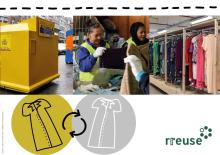
With textiles rightly rising as a key priority under the new European Commission, this document outlines RREUSE’s vision on how to achieve a more inclusive and circular textile sector that prioritises re-use and emphasises the role of social enterprises in the value chain as part of the solution.
This paper also provides a number of key recommendations as to what specific actions the Commission should address when developing policy initiatives for the sector.
The Fibersort project aims at realising the widespread implementation of the automated sorting technology by validating it as a key value adding innovation to enable textile-to-textile recycling.
While the challenges and opportunities of used textiles are increasingly in the spotlight of governments, industry, and civil society, considerable system changes are required to transition towards a circular economy for textiles. Throughout this report, policy recommendations are formulated showing the legislative, economic and soft instruments that regional, national and the European governments have at their disposal to create an enabling environment for textiles collection, sorting and recycling at scale.
Destination Climate Neutrality brings together leading recommendations of think tanks, scientists, thought leaders and NGOs to offer a policy blueprint for how best to propel Europe towards net zero carbon emissions in the coming 5 years of the Von der Leyen term. It offers sector-by-sector analysis, targets and initiatives in governance, finance, industry, energy, transport, the circular economy, agriculture and employment.
On circular economy, the report sees challenges in:
a lack of EU targets for waste prevention, reuse, repair and refurbishment
no monitoring framework for material flows
contamination of materials by hazardous ingredients
high demand for biomass.
The authors identify opportunities in job creation, cleaner supply chains and product policies.
Businesses across Europe are fully engaged to maximise the value of materials, transition to circular business models and achieve a circular economy. This can be best achieved through a functioning market for secondary raw materials (SRMs) and circular products. A real market for SRMs requires a global level-playing field with similar regulatory frameworks and standards, but within the EU several challenges and untapped opportunities still remain. Among others, BusinessEurope recommends policy-makers to put more emphasis on removing inconsistencies and filling the gaps in the current policy framework, starting with a better implementation of the existing waste acquis, including more guidance to Member States and performing ex-post impact assessments on the benefits of full compliance.
The transition to a more circular economy is underway. But what can be done to speed it up? This report, authored by Institut Montaigne, recommends five principles that must drive circular economy policy:
focus on innovation
adopt a comprehensive, global approach
take into account differences between sectors and enhance public / private cooperation
On the occasion of the World Circular Economy Forum (WCEF), held on 4-5 June 2019 in Helsinki, the Architects' Council of Europe (ACE) published a Statement highlighting the importance of design to achieve more circularity in the construction and building sector, as well the solutions that architecture can bring.
Like many other sectors, the construction and building sectors operate largely within a linear economy model of “take, make and waste”. Yet, there is growing awareness of the finite nature of natural resources and fragility of our environment, and thereby of the urgent need to develop more sustainable and regenerative economic models.
Architecture has a crucial role to play here as many decisions taken during the design phase have long-lasting consequences on the environment.
One of the Interreg DTP MOVECO (Mobilizing Institutional Learning for Better Exploitation of Research and Innovation for the Circular Economy)project results is the Transnational Strategy to accelerate transition towards a circular economy in the Danube region.
Be transnational – reducing disparities within the Danube Region can only happen through cooperation, capacity building and knowledge exchange across borders. This holds also true for the implementation of the circular economy to make the Danube Region, as a resource poor region, less dependent on imported primary resources.
MOVECO identified key challenges with regard to the transition towards a circular economy and offers recommendations for progress. The strategy further provides the reader with many good practice examples.
These include an observation that the 28,000 tonnes of Category 3 IT equipment being shipped for repair or reuse annually in Europe represent only 2.2% of ICT products placed on the market, and 4.5% of the e-waste collected.
The strategies being applied to ensure longevity in the digital industry are also insufficiently comprehensive. In practice the lifetime of many IT products is linked to that of the battery.