Report

  • Upload document

    Good practices in separate collection, sorting and recycling of steel for packaging

    Steel
    Type
    Author
    APEAL
    Publication Date
    06/2018
    Country
    EU
    Language for original content
    Steve Claus

    With an average of 79.5% recycled across Europe in 2016, steel for packaging is already the most recycled packaging material in Europe.

    This report compiles examples of good practices from countries across the EU showcasing the varied projects, systems and processes by which steel for packaging is recycled, bringing significant reduction in emissions, resource and energy use.

    Steel, a permanent material that can be infinitely recycled to make high quality products, can be easily sorted from the waste stream owing to its magnetic properties which make it the most economical packaging material to collect, sort and recycle over and over again.

    Good practices in separate collection, sorting and recycling of steel for packaging contribute to improving its recycling rate.

  • Upload document

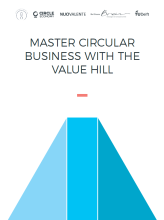
    Master Circular Business with the Value Hill

    Master Circular Business with the Value Hill
    Type
    Author
    Elisa Achterberg
    Jeroen Hinfelaar
    Nancy Bocken
    Publication Date
    09/2016
    Country
    Netherlands
    Language for original content
    Harald Friedl

    Although the opportunities for investing in circular business models are widely available, current investment methods do not match the needs of these particular businesses. Businesses need to create an attractive business model for financiers, and financiers need to change the way they perceive the risks and opportunities associated with these models.

    To help businesses position themselves in a circular context and develop future strategies for doing business in a circular economy, Sustainable Finance LabCircle EconomyNuovalenteTUDelft, and het Groene Brein got together to create the Value Hill that proposes a categorisation based on the lifecycle phases of a product: pre-, in- and post-use.

  • Upload document

    Circularity Gap Report 2019

    2019
    Type
    Author
    Circle Economy
    Publication Date
    01/2019
    Country
    Netherlands
    Language for original content
    Harald Friedl

    The Circularity Gap Report 2019 finds that just 9% of the 92.8 billion tonnes of minerals, fossil fuels, metals and biomass that enter the economy are re-used annually. Circle Economy calculates that 62% of global greenhouse gas emissions are released during the extraction, processing and manufacturing of goods to serve society’s needs; only 38% are emitted in the delivery and use of products and services.

    It highlights the vast scope to reduce greenhouse gas emissions by applying circular principles - re-use, re-manufacturing and re-cycling - to key sectors such as the built environment. Most governments barely consider circular economy measures in policies aimed at meeting the UN target of limiting global warming to 1.5°C above pre-industrial levels.

  • Upload document

    CEMBUREAU - Building Carbon Neutrality in Europe

    Cemberau
    Type
    Author
    CEMBUREAU - the European Cement Association
    Publication Date
    10/2018
    Country
    Belgium
    Language for original content
    Scope
    Nikos Nikolakakos

    Europe has an ambitious vision of a carbon-neutral future, a vision that integrates energy-intensive industries as well as the construction sector and its entire value chain.

    Cement, which binds concrete together, is at the heart of solutions to turn this vision into reality. These solutions span over the entire cement and concrete value chain: from raw materials to production, use, re-use, and recycling.

    CEMBUREAU, the European Cement Association, as part of its effort to move towards a carbon-neutral construction sector, has taken stock of progress done since the publication of its 2050 Low Carbon Roadmap in 2013 and mapped routes to a resource-efficient and carbon-neutral built environment.

  • Upload document

    Destination: a circular tourism economy

    Destination: a circular tourism economy
    Type
    Author
    Centre for Regional & Tourism Research (CRT)
    Publication Date
    08/2018
    Country
    Denmark
    Language for original content
    Scope

    Destination: a circular tourism economy aims to increase the innovativeness of small and medium-sized enterprises (SMEs) within the tourism sector by supporting the integration of circular economy elements into their services, products and business models. This handbook is the result of work carried out in the Interreg South Baltic innovation project, CIRTOINNO.

    In addition to providing an overall understanding of the concept of circular economy and the specificities of tourism and the South Baltic partner regions, the CIRTOINNO handbook investigates and discusses the opportunities and barriers for tourism SMEs to adopt circular economy principles, and identifies best practices.

  • Type
    Author
    Enel
    Symbola
    Publication Date
    03/2018
    Country
    Italy
    Language for original content
    Scope
    CircularEconomy@ENEL

    100 Italian circular economy stories compiles successful innovations from companies, research institutes and non-profits across 11 sectors throughout Italy. Their stories show the transition towards a circular economy is gaining traction on the ground as a sustainable alternative to the incumbent methods of production.

    A circular economy will not happen through policy alone: it requires companies, start-ups, foundations, research centres, universities, consortia and associations to apply the principles of a circular economy to practice. This book features 100 such examples from Italy, including Aquafil's regenerated nylon yarn and Favini's non-virgin papers. The whole collection of stories ranges from across the following 11 sectors:

    • Clothing and accessories
    • Agri-food
    • Furniture / Construction
    • Industrial automation and other Manufacturing
    • Chemistry and Pharmaceutics
    • Research & Development
    • Electrics and Electronics
    • New Materials and Resources
    • Enablers and Platforms
    • Promotion and Dissemination

    ​​These 100 stories clearly demonstrate that change is underway by showing how Italian products are brought to market using increasingly integrated technologies and supply chains which exchange materials and energy. The diffusion of such circular processes will enable more and more companies to free themselves from using costly virgin resources, gradually rendering the whole economy more sustainable.

    For reference with the Italian circular economy strategy, please check the 2017 white paper "Towards a model of circular economy in Italy"

  • Type
    Author
    LE Europe
    VVA
    Ipsos
    ConPolicy
    Trinomics
    Publication Date
    10/2018
    Country
    EU
    Language for original content
    Key Area
    Scope
    Jeroen van laer

    To obtain empirical policy-relevant insights to assist with the implementation of the EU Circular Economy Action Plan, the European Commission requested a behavourial study that aimed to:

    1. identify barriers and trade-offs faced by consumers when deciding whether to engage in the CE, in  particular whether to purchase a more or a less durable good, whether to have a good repaired, or to discard it and buy a replacement;
    2. establish the relative importance of economic, social and psychological factors that govern the extent to  which  consumers engage in the CE, especially purchasing durable products and seeking to repair products instead of disposing of them; and
    3. propose policy tools to enable and encourage consumers to engage in CE practices related to durability and reparability.

    The study focused on five products: vacuum cleaners, televisions, dishwashers, smartphones and clothes. The methodology encompasses a systematic literature review, 50 stakeholder interviews, consumer focus groups, an online consumer survey with 12,064 participants, and a behavourial experiment with 6,042 participants. Whereas the survey collected information on consumers' perception of and experiences with circular practices, the financially incentivised experiments included a repairing and purchasing task.

    Findings include a general willingness to engage but little practical action to date. Consumers appear to be hampered by insufficiently developed markets for repair, reuse and refurbish in addition to a lack of information regarding product durability and repairability. Such information appeared seminal in shifting purchasing decisions towards sustainable products in the behavourial experiment, highlighting great potential to bridge the gap between theoretical and practical engagement. This experiment also uncovered substantial consistency between a self-reported circular mindset and corresponding behaviour.

    As product size and price increases, consumers also appear to have greater interest in repairability and durability. Whereas repairability is linked to spare parts, durability appears to follow from perceived product quality. Overall this study concludes that the price-quality ratio, followed by convenience, is the most important driver and simultaneously barrier for consumer engagement in the circular economy. Building on these finidngs, the study makes 5 recommendations for policy action to enhance consumer engagement in the circular economy:

    • boost CE engagement by increasing awareness of the circular economy;
    • make repairing products easier;
    • create financial incentives for repairability and durability;
    • make information on durability and repairability available at point of sale;
    • strengthen legislation requiring the provision of accurate information to consumers.

  • Upload document

    Circular Economy in the Furniture Sector: Overview of Current Challenges and Competence Needs

    Circular Economy in the Furniture Sector
    Type
    Author
    Ecores
    University of Vaasa
    CETEM - Technological Centre of Furniture and Wood
    AMUEBLA - Innovative business association of furniture manufacturers and related in the Murcia Region
    CENFIM - Home & Contract furnishings cluster
    KIT - karlsruhe Institute of Technology
    Publication Date
    09/2018
    Country
    Spain
    Language for original content
    Key Area
    Sector
    Scope
    Juan Jose Ortega (Amuebla) | Erwan Mouazan

    The report ‘Circular Economy in the Furniture Sector: Overview of Current Challenges and Competence Needs’, provides an overview on how the circular economy is currently being implemented within the furniture sector.

    By focusing on existing practices, challenges and opportunities at the micro-level, the main objective of this report is to identify the necessary skills and competences needed to support the transformation of furniture companies towards a circular economy.

    Project partners identified 25 furniture companies active in the circular economy throughout Europe.

    Interviews, held between March and May 2018 in Belgium, Finland, Germany, Spain, France, The Netherlands, Italy and Sweden, yielded insights on the necessary skills and competences needed to develop circular business.

  • Upload document

    Beyond the CE package: Maintaining momentum on resource efficiency

    Beyond the CE package
    Type
    Author
    Aldersgate Group
    Publication Date
    12/2017
    Country
    United Kingdom
    Language for original content
    Scope

    Despite resource efficiency improving 41% between 2000 and 2016,with  the Circular Economy Package and the initiatives set out in the accompanying Action Plan nearing completion, the EU institutions must acknowledge that the move to a more resource efficient or “circular” economy will take time. To invest in new business models, more resource-efficient processes and new supply chains for good quality secondary materials, businesses need the assurance that the resource efficiency agenda will remain a priority for the EU in the long term.

    This briefing sets out a range of policy recommendations that the Aldersgate Group believe EU institutions should continue to pursue beyond completion of the Circular Economy Package to scale up business action on resource efficiency.

  • Upload document

    Circular City Governance: An explorative research study into current barriers and governance practices in circular city transitions across Europe

    Circular City Governance
    Type
    Author
    Jan Jonker
    Naomi Montenegro Navarro
    Publication Date
    11/2017
    Country
    Slovenia
    Language for original content
    Scope
    Jan Jonker

    Circular City Governance - An explorative research study presents the results of an empirical research study into current barriers and governance practices in circular city transitions across Europe carried out by a team from the Radboud University Nijmegen School of Management (NL). The research activities ran from October to December 2017. The main objective of the study was to support the European Investment Bank (EIB) and other members of the Urban Agenda Partnership on Circular Economy involved in the working group on “Circular City Governance” (CCG) with the identification, analysis and elaboration of actions in support of Circular Governance in Cities, particularly through better knowledge and better funding.