RE-PLAN CITY LIFE - Shaping circular cities
Type of organisation or company
Country
EU
Language for original content
Scope

The RE-PLAN CITY LIFE project aims to raise awareness about the circular economy potential of materials, products and applications obtained from tyre recycling and encourage the uptake of environmentally-friendly behaviour and practice in urban communities.

Its platform includes a community and marketplace for exchanging practical information about recycled tyre materials and a calculator for assessing the circularity and environmental impact of products.

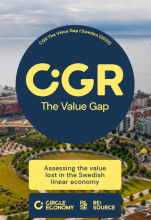
CGR The Value Gap:  Sweden – Assessing the value lost in the Swedish linear economy – Circle Economy, RISE, RE-SOURCE
Type
Author
Carl Jensen (RISE), Andrew Keys (Circle Economy), Julie Lebreton (Circle Economy), Ann-Charlotte Mellquist (RISE), Megan Murdie (Circle Economy), Marc de Wit (Circle Economy), Peter Stigson (RISE)
Publication Date
11/2025
Country
Netherlands
Language for original content
Scope

This report explores the links between circularity and economic value, offering a new perspective on how linear practices lead to economic inefficiencies.

CGR has built up a huge body of data by mapping material flows, and this report uses that as a basis to look further and ask about the economic value of the materials we use, the products we consume and the systems we build—and where value is lost or not created.

Current economic models leave substantial value untapped: resources are over-extracted, materials wasted, products underused, and social and economic opportunities missed. The report looks at value creation and loss in mining & extraction, manufacturing, agrifood, construction, mobility and consumables. It also explores the circular potential in each sector.


European Commission logo
News type
Sector
Scope

The Commission is holding a public consultation on how to improve EU product legislation, specifically regarding the circular economy and the digital transition. It relates to the revision of the New Legislative Framework: established in 2008, it provides a blueprint for product harmonisation legislation, aligning 30 EU legal acts. 

Deadline: 4 February!

The new SOLRESS project will be working on developing safer, sustainable and high-performance bio-based solvents for European industries, using organic waste as a feedstock. 

The EU Food Loss and Waste Prevention Hub is a one-stop-shop for stakeholders active in the area of food loss and waste prevention and reduction, across the EU and beyond. It's a source of information on what's going on in this community!

The ECESP website has a good selection of circular bioeconomy-themed content. We'll be shining a spotlight on some of it here!

This item looks at a database of technologies using bio-waste.

The logo of Loop (region de Murcia) by cetenma. Under the logo is written: the observatory of circular economy and business sustainability of the region of Murcia
Type of organisation or company
Country
Spain
Language for original content
Scope

This collection of businesses in the Region of Murcia which are delivering on circular economy principles is an interactive tool. It is intended to be a source of inspiration and information: users can search for businesses active in specific sectors or focusing on specific circular economy principles.

Upload document

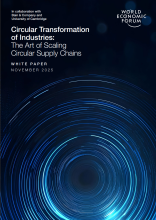
Circular transformation of industries: the art of scaling circular supply chains

Front page of the report. Black background with neon blue lines going in a circle. The text reads: In collaboration with Bain & Company and University of Cambridge. Circular Transformation of Industries: The Art of Scaling Circular Supply Chains. White Paper November 2025. At the top right is the World Economic Forum logo.
Type
Author
World Economic Forum
Bain & Company
University of Cambridge
Publication Date
11/2025
Country
Other
Language for original content
Scope

Businesses across industries increasingly recognise circularity as a strategic lever for resilience, competitiveness and growth. Sourcing rare earths and other critical minerals is also becoming a geopolitical challenge, making the case for circular supply chains.

The conversation has shifted from why circularity matters to how it can be implemented at scale. However, circular strategies are complex to operationalise, so companies require clear priorities, smart design and strong partnerships to overcome scaling challenges.

This white paper outlines methods for prioritisation, approaches to design circular supply chains and key enablers that are essential for scale. It offers leaders actionable strategies to unlock economic value and accelerate circular transformation.

Subscribe to