If you want to help shape EU plans for a more sustainable built environment, it is time to have your say by responding to a consultation that supports the development of a new Commission roadmap for reducing whole life carbon in the building sector.
On 13 July 2023 the Commission adopted a Proposal for a Regulation on circularity requirements for vehicle design and on management of end-of-life vehicles.
This proposed Regulation lays down circularity requirements on vehicle design and production related to reusability, recyclability and recoverability and the use of recycled content, and on information and labelling requirements on parts, components and materials in vehicles.
It also lays down requirements on extended producer responsibility, collection and treatment of end-of-life vehicles, as well as on the export of used vehicles from the Union to third countries.
Hutoepito has been awarded a HUF 197.85 million non-refundable grant by the Hungarian Ministry of Finance to fund research, development and innovation activities under the Upcycling of closed-cell rigid polyurethane foams project.
The widespread use of polyurethane foams in various industrial technologies produces high volumes of rigid PU foam waste. Proper handling of this is essential for environmental, social and economic reasons.
The goal is to produce upcycled polyurethane foam products.
The researchers first identified the upcycling opportunities of closed-cell polyurethane foam materials and purchased the necessary machinery. Later, they started production of upcycled polyurethane foam blocks and sheets, and now they are developing prototypes.
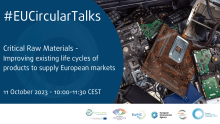
Raw materials are crucial to Europe's economy, and sustainable access to these materials is key for net zero objectives. However, Europe relies heavily on imports, mostly from third-country suppliers. It needs to mitigate supply chain risk arising from this strategic dependency in order to enhance its economic resilience.
The ECESP Leadership Group on Critical Raw Materials is holding this #EUCircularTalks on 11 October to highlight opportunities to improve existing life cycles for products containing CRMs.
Join us and explore how EU policy can scale up improvement opportunities and overcome the obstacles to creating a more circular economy for products reliant upon CRMs.
"Dialogues on the Circular Economy: Strategies for Transitioning from Food Waste Reduction to Zero Food Waste in the EU" will be held by Greenio on 4 September 2023 in Paris. The event will bring together top minds in sustainability, business and policy to explore and promote effective strategies for eliminating food waste in the European Union.
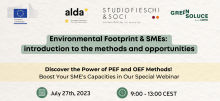
The European Commission is hosting a webinar on 27 July on the implementation of Product and Organisation Environmental Footprint methods. Find out about these methods, a tool for assessing, reporting and achieving circularity throughout the life cycle.
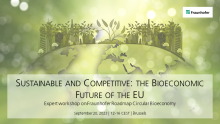
On 20 September, the Fraunhofer EU Office in Brussels will be holding a workshop to discuss its Roadmap for the Future Development of the Circular Bioeconomy. The workshop will explore the scientific and technological potential and challenges of the bioeconomy, how the bioeconomy can meet ecological and socioeconomic needs, and the policy framework needed to achieve this.
Participants will seek to identify solutions for the four application areas of bioeconomy: nutrition, biomass material utilisation, CO2 value creation and the socio-economic aspects of the bioeconomy.
The European Recycling Conference 2023 will take place on 28 September in Brussels.
This year, EURIC is teaming up with DENUO, the Belgian waste management and recycling federation, to shine a spotlight on car recycling. Why? The automotive industry is going through a major revolution. By 2035 - practically tomorrow in terms of industrial value chains - combustion engine vehicles will be phased out and replaced by electric vehicles (EVs). This transition will have a significant impact on all the players involved, considering that the industry provides 12.6 million direct and indirect jobs in the EU. Recycling is no exception.
The European Commission has launched a new call for tenders under the European Maritime, Fisheries and Aquaculture Fund (EMFAF) which will be particularly relevant to stakeholders working on ship recycling.
The call will finance a study providing the European Commission with an up-to-date analysis of the economic dynamics and effects of the use of controversial open registers for vessels, including the impact on the environment.
The boating industry in Europe, represented by EBI (European Boating Industry), has developed a roadmap for solving the roadblocks to end-of-life boat recycling. It sets ambitious targets and policy recommendations to reach by 2030. The boating industry also commits to phasing out unsustainable recycling practices.
The roadmap and recommendations were developed by EBI following the work of the Stakeholders’ Group on end-of-life recreational boats. The Group is co-chaired by the European Commission's DG MARE and EBI and includes national authorities of the Member States and key stakeholders (industry, users, academia and related industries).