The workshops on Nutrient recycling policy will be held by the European Sustainable Phosphorus Platform in Brussels and online on 12-14 March 2024.
Objectives:
To elaborate ambitious, feasible and consensus proposals for regulatory targets for phosphorus and nitrogen reuse-recycling from municipal wastewater and
To identify policy tools to support market pull for recycled nutrients which could achieve consensus across industry and users.
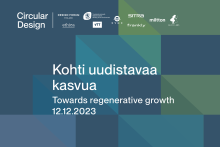
The one year long national Circular Design pilot programme is coming to an end! What did the companies get out of the programme? What did they achieve?
The results of the programme will be shared on 12 December in a hybrid event at 13:00 - 15:00 EET (12:00 - 14:00 CET), which is a World Circular Economy Forum side event.
A Circular Economy and Resource Efficiency conference with a multi-disciplinary perspective on how circular economy can be deployed to effect change in the day-to-day practice will be held in in Trondheim (Norway) and online by NTNU Sustainability.
Extended Producer Responsibility (EPR) is one of the key policies requiring EU Member States to organise separate collection of textile waste as of 2025. EPR schemes are an important tool for reducing the environmental impact of textiles, promoting circularity and contributing to more efficient end-of-life management.
Join the hybrid event on EPR for circularity: towards a more sustainable EU textile sector on
29 November from 15:00 to 17:30 CET at the European Parliament or online.
This catalogue aims to provide waste management experts and decision makers in the Mediterranean region with an overview of successful practices, solutions and approaches in waste separation, collection, treatment and recycling in the Mediterranean.
It examines five projects spanning this region and covering issues such as employing a circular economy approach for the organic fraction of municipal solid waste management. It also highlights the lessons that should be considered when replicating successes and avoiding pitfalls.
As part of the new EU-funded Circular Economy project, the Green Growth Knowledge Partnership aims to establish a community of practice for organisations involved in circular economy activities. If you would like to participate, please complete this 3-minute survey.
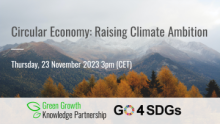
On 23 November (15:00-16:30 CET), the Green Growth Knowledge Partnership (GGKP) and Global Opportunities for Sustainable Development Goals (GO4SDGs) will host a webinar on “Circular economy: raising climate ambition”.
The first in a series accompanying multilateral meetings over the next 12 months, this webinar will explore how applying the circular economy approach can support the goals of COP28.
The Asia-Europe Environment Forum supports entrepreneurs committed to driving circularity in their businesses and provides an opportunity to discuss the circular transition of SMEs. This year, the Forum will be organising a conference on Empowering innovation in Asia & Europe - SMEs at the heart of circular transition, to take place on 21 and 22 November in Brussels.
The Biomodel4Regions project, with the help of ICLEI Europe, is looking for two regions or clusters in Northern, Mediterranean, Eastern or Central-Western Europe keen to develop their own bio-based economy strategy covering agri-food, forestry, shellfish or Organic Fraction of Municipal Solid Waste (OFMSW).
Interested regions can apply up until 1 December 2023.
On 6 November 2023, Arthur ten Wolde, ECESP Coordination Group member and Executive Director of Ecopreneur.eu, represented the Platform at a G7-B7 online meeting on Circular Economy and Resource Efficiency Principles. Mr Ten Wolde has been a member of the European Circular Economy Stakeholder Platform since its foundation in 2017.
The meeting was organised as part of the G7 Sapporo Ministers’ Meeting on Climate, Energy and the Environment in Japan. The Group of Seven (G7) is an intergovernmental political forum consisting of Canada, France, Germany, Italy, Japan, the UK, the USA and the EU. TheBusiness7 group (B7) is the G7 platform for dialogue with the international business community, consisting of the industry and employers’ associations from the G7 including BusinessEurope.