Gees Recycling's "Retracking" project aims to help lay the groundwork for moving the fibreglass manufacturing sector from a linear to a circular economy by proposing a circular model able to produce a secondary raw material from fibre-reinforced composite waste.
The transformation into a circular economy entails factoring resource flows into production, sales and consumption processes and thus massively reducing the use of materials (raw or otherwise), as well as the volume of waste and the strain on the environment.
Austria's circular economy strategy therefore aims to:
This International Labour Organization (ILO) report analyses the impact of the transition to low-carbon and resource-efficient economies, providing new insights into likely occupational skill effects in declining and growing industries by 2030 based on the global scenarios of "energy sustainability" and "circular economy". Evidence of good practices collected demonstrates how skills development can underpin the green transition.
Health Care Without Harm (HCWH) Europe is announcing a one-day event focusing on Circular Healthcare. Their training session to be held in Brussels on 28 November 2023 is aimed at transforming how to approach healthcare practices and implementing principles from the waste hierarchy in the sector.
Its objectives:
Learn how to reduce plastic and its impacts on health and the environment
Discover how to prevent waste and introduce reusable alternatives in healthcare settings
Explore how to eliminate harmful chemicals from healthcare products and processes
Engage in discussions on sustainable procurement and circular business models for healthcare
Network with fellow Circular Healthcare practitioners and innovators from across Europe.
The 4th International Conference on Strategies toward Green Deal Implementation – Water, Raw Materials & Energy (ICGreenDeal2023) will take place on 14-15 December. It will tackle climate change and ways to prevent it, including innovative solutions (technological, environmental, economic and social) that can be implemented under the Green Deal Strategies.
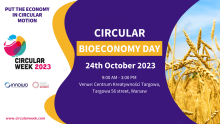
The Circular Bioeconomy Day on 24 October serves as a platform for sharing knowledge about bio-based solutions in the spirit of interdisciplinary cooperation.
The event is a part of Circular Week 2023 and brings together a diverse group of stakeholders, including policymakers from the EU, regional government representatives, local administration, businesses, NGOs, academia visionaries, thought leaders and experts, to celebrate and explore the remarkable potential of the circular bioeconomy and the pivotal role of its strategies in driving the transition towards a circular economy.
Despite growing efforts by political bodies, companies and researchers to support the transition towards a more sustainable and circular economy, we are still behind schedule.
The seminar on 17 October will address the following challenges that are slowing down this transition:
the need for quantitative but easy-to-handle methods to support decision-making in the product design phase, particularly concerning material selection for sustainability,
the potential rebound effects that undercut the expected sustainability gains of moves towards circularity.
This book collates leading-edge research and industry best practice to provide a ‘one-stop shop’ exploring the complex and interconnected issues surrounding sustainability in the sector.
It includes innovative examples from different regions, addressing topics from policies to supply chain issues and materials innovation. Five unique case studies of sustainable businesses provide examples of pioneering practice. The book brings together both academic and industry perspectives on the critical areas that require immediate action to move towards a more sustainable fashion, clothing and textile sector.
Part VI features five chapters by leading authors covering the circular economy in the sector, including a chapter by Professor Jacqueline Cramer.
The ECOSWEEE project has received EU funding under the LIFE programme. It aims to increase the collection rate of small WEEE and portable batteries.
The project recognises the importance of stakeholder engagement as a catalyst for change. It aims to create a collaborative platform on Linkedin where stakeholders can come together, share knowledge, and collectively work towards improving collection rates and promoting sustainable practices.
The project will harness the power of stakeholders' expertise and commitment to drive tangible impact and contribute to a more sustainable future.
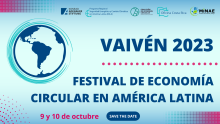
VAIVÉN 2023: Circular Economy Festival is a meeting and exchange space of the Circular Economy Coalition for Latin America and the Caribbean that seeks to promote and celebrate the development of the circular economy in the region.