The Asia-Europe Environment Forum (ENVForum) Workshop Series on Circular Plastic Use: Innovate & Change to Close the Loop offers participants the opportunity to design and implement innovative solutions in the field of circular plastic use and waste management. This project planned for June 2021 is organized in association with INNOWO.
More than ever during the COVID-19 crisis, the circular economy has asserted itself as the model that can accompany recovery and enable a higher and better growth, through a systemic vision that makes it possible to tackle the most relevant challenges nowadays: the climate crisis and the environmental impact.
Companies must heighten their ambitions over the next Decade of Action, to achieve the United Nations' Sustainable Development Goals (SDG), by adopting a production and consumption model by 2030 that allows societies to keep growing economically, but under planetary boundaries and in the light of societal challenges.
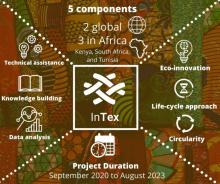
"Innovative Business Practices and Economic Models in the Textile Value Chain" (InTex) is a three-year UNEP project funded by the European Union. The InTex project has five components, two with global reach and three focusing on national implementation in three African countries: Kenya, South Africa and Tunisia.
A new partnership led by the UNIDO is looking for interested organisations to express their interest in joining ‘SWITCH to Circular Economy Value Chains’ - a five-year European Union-funded project that aims to accelerate the transition to more circular value chains (namely textiles and garments, and plastic packaging) in developing countries.
Commissioned by the Scientific and Technical Advisory Panel (STAP), which advises the Global Environment Facility (GEF), and co-authored by Circle Economy and Shifting Paradigms, this report uncovers the range of socio-economic and environmental co-benefits that circular mitigation interventions can bring to GEF countries of operation.
The report supports strategic advice by the STAP to the GEF and its implementing partners, and helps carve out a role for these bodies in accelerating the transition to a low-carbon circular economy. Its findings will be highly relevant to the development of future GEF projects and programmes across its different focal areas.
Every day, it is clearer that we cannot lose any more time in switching away from a linear economy. The climate emergency together with the economic crisis bringing the region to its knees are basically a perfect storm: to avoid being hit by it, we need to make an eco-innovative transition a priority if we want a more sustainable future for the Mediterranean.
The term "eco-innovation" basically boils down to innovation. What does eco-innovation really mean? And what is the link between eco-innovation and a more circular economy, particularly in the Mediterranean region?
A wide range of initiatives and programmes point towards innovation being key to enabling green growth. Eco-innovation and the circular economy: are they two sides of the same coin?
It is becoming clearer - and more urgent - every day that we need to abandon the linear economy. The climate emergency together with the economic crisis that the region is experiencing makes a transition based on eco-innovation a priority for a more sustainable future for the Mediterranean.
Textile products have a tremendous ecological footprint at all stages of their lives. This new report by the Environmental Coalition on Standards (ECOS), provides a comprehensive analysis of the current situation and goes on to explore the policies and standardisation actions needed to advance towards circular textiles, building on the lessons learnt from the implementation of the ecodesign approach in other sectors.
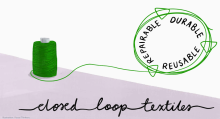
ECOS argues that textile products put on the EU market should comply with a minimum level of sustainability. Mandatory ecodesign requirements for textiles are needed to address minimum lifetime, as well as durability, reusability, repairability, recyclability, prevent the presence of hazardous chemicals, and limit microplastics release at all stages.
Spain manufactures 14% of all agricultural plastics in Europe. To optimize recovery of mulch films in the form of quality compost, AIMPLAS is developing the AGRO+ Project with funding from the Valencian Innovation Agency (AVI)