The Green Product Awards will host a full-day event comprising the Summit and the awards ceremony.
Find out about how requirements for communication, material selection, product design, repairability and packaging changing are changing and what that means in practice, then celebrate the Green Product Awards winners!
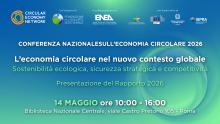
The Conference will serve as a platform for dialogue on national and European strategies with a view to the EU's Circular Economy Act, foster discussion among businesses, institutions, associations and research organisations, and present the 2026 Circular Economy Report.
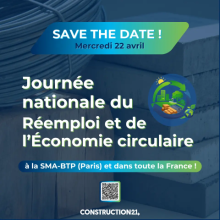
The National Day of Reuse and the Circular Economy will take place in several venues across France. Take part in this event which aims to speed up the transformation of the construction sector.
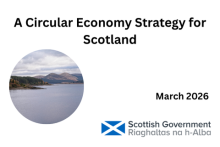
The strategy aims to make a robust and successful circular economy a central pillar in driving Scotland’s innovation and growth towards a sustainable future.
Published in March 2026, it sets out what Scotland aims to achieve by 2045. It focuses on sectors and products in order to optimise the impacts of individual materials, such as plastics, critical materials and chemicals, across the supply chain as a whole.
The goal is to make Scotland a net zero and nature-positive nation, helped by the significant progress in transitioning towards a circular economy with sustainable levels of material use. Scotland will have a thriving economy that meets societal needs and is based on circular economy principles, and will have reduced the negative global impact of its production and consumption.
Myteria is an early-stage biomaterials initiative from the Netherlands developing circular interior panels grown from mycelium and locally sourced agricultural residues.
It rethinks how materials are made: instead of extracting and processing, they grow them using nature’s own binding system.
This study explores how social ties and social impact can be accounted for in circular economy initiatives.
It examines how a local project managing organic waste and unsold goods fosters social ties in a priority urban neighborhood in France, and how these dynamics can be grasped using an alternative qualitative accounting approach.
It identifies key creators of social ties within local initiatives, proposes a social balance sheet highlighting factors that stimulate or undermine these ties and introduces a methodological approach for counting or recounting social impact in circular economy projects.
As the EU introduces Extended Producer Responsibility (EPR) for textiles under Directive 1892/2025, this conference explores how Romania can implement EPR for textiles, develop separate collection systems and accelerate reuse, upcycling and recycling
The eighth annual conference of the Italian Platform of Actors for the Circular Economy (ICESP) will be an opportunity to discuss good practices in the circular economy.
Learn about why they are important and how they can drive the circular transition!
Industrial-Urban Symbiosis (I-US) connects industries and cities to repurpose by-products, energy, water, and expertise, hereby minimising waste, cutting costs, and advancing EU Circular Economy goals.
This event will bring together experts, policymakers, researchers and practitioners to discuss how innovation, governance and finance can accelerate the transition toward a circular economy.