The Royal Swedish Academy of Engineering Sciences (IVA) has always been a meeting place for Sweden’s future. It builds bridges between the business community, the public sector, academia and the political sphere.
Its two-year project "Resource Effectiveness and the Circular Economy" was aimed at making Sweden more competitive in a future with finite resources, in line with the UN’s Sustainable Development Goals, by economising on resources and developing new technologies, services and business models in five areas:
premises,
mobility,
textiles,
food and
plastics.
Read the synthesis report, marking the completion of the project, which presents the most important conclusions, recommendations and action plans from the five subprojects.
AIMPLAS - a consortium member of the OCEANETS project - has developed a material that ensures the traceability of fabric made from end-of-life fishing nets. When exposed to infrared radiation, the material changes colour and so helps identify where it came from.
This research note produced by Ecopreneur.eu is a 1st inventory of the potential impacts of future EU circular fashion on non-European textile producing countries. It uses existing literature and input from four circular economy experts to analyse the economic, social and environmental impacts.
Textiles and clothing play an important role in our everyday life. But the global fashion industry model is unsustainable. It uses large amounts of resources and has negative impacts on the environment and people. The global fashion industry, therefore, has to make a transition towards a circular model. In a ‘circular’ fashion economy, clothes, textiles, and fibres are kept at their highest value during use and re-enter the economy to avoid becoming waste.
This research note produced by Ecopreneur.eu is a first inventory of the potential impacts of future EU circular fashion on non-European textile producing countries. It uses existing literature and input from four circular economy experts to analyse the economic, social and environmental impacts.
A broad coalition of social and environmental NGOs has developed a strategy for sustainable textile, garments, leather and footwear. It looks at the social, environmental and governance implications of the textile sector in one forward-looking document ahead of the comprehensive EU Strategy for Textiles, expected in 2021.
The document aims to contribute to the upcoming comprehensive EU Strategy for Textiles, by providing recommendations on what such a strategy should encompass in order to maintain a high level of ambition. It includes forward-looking proposals on due diligence, product policy framework, waste, unfair trading practices, international trade, support to producing countries, alternative business models and a multi-stakeholder platform.
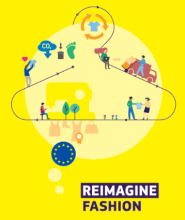
Launched in memory of social innovation pioneer Diogo Vasconcelos, the European Social Innovation Competition is run by the European Commission across all EU Member States and Horizon 2020 Associated Countries. The theme this year is Reimagine Fashion.
Professor Rebecca Earley introduces a series of short films about the design tools produced at the Chelsea College of Arts research centre, and how to use them to become a more sustainable and circular designer. The series aims to help designers access and use the research resources to stay inspired and motivated to design better futures.