R-PVC Hub aims to promote cooperation between all stakeholders in the PVC recycling sector, including the businesses collecting waste, processing it and producing items containing recycled material.
One goal of the platform is to inform stakeholders about national and European rules on PVC waste and technological innovations in the field of waste sorting and management and the definition of by-products, waste and secondary raw materials.
It also links up supply and demand: businesses list what they have or need and the precise specifications of the PVC.
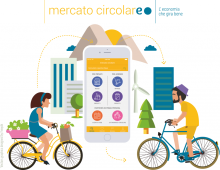
An app which enables users to buy circular goods and services near them or online and provides reliable information on what exactly the circular economy means.
Despite companies face several challenges when redesigning their supply chain for the Circular Economy, current literature lacks a systematisation of such challenges and of the ways to overcome them.
Through a systematic literature review, this paper identifies and identifies 24 challenges that may hamper a supply chain redesign for the Circular Economy. Sixteen of these challenges are well known from research in related topics. On the other hand, the remaining eight are relatively new or take on a different relevance within the Circular Economy context.
A multiple case study in the household appliance supply chain has been carried out to explore how these challenges appear in practice and how companies may tackle them.
These include an observation that the 28,000 tonnes of Category 3 IT equipment being shipped for repair or reuse annually in Europe represent only 2.2% of ICT products placed on the market, and 4.5% of the e-waste collected.
The strategies being applied to ensure longevity in the digital industry are also insufficiently comprehensive. In practice the lifetime of many IT products is linked to that of the battery.
In "The contribution of the Digital Industry to repair, remanufacturing and refurbishment in a Circular Economy”, DIGITALEUROPE describes longstanding business practices in the ICT sector which represent, next to waste collection and treatment facilities, the circular economy backbone of the ICT industry in Europe.
With roughly 28,000 tons of IT equipment and spare parts being shipped cross-border annually in Europe, the ICT sector is adopting circular business practices such as designing for longevity, durability and reliability, stimulating reuse, and facilitating refurbishment. There is significant market opportunity for circular economy in the ICT sector: in 2015, the business of refurbishing IT equipment already accounted for €3.1 billion in annual turnover.
European Commission, Open Innovation 2.0 Yearbook 2017-2018, Publications Office of the European Union, Luxembourg, Caterina Berbenni-Rehm, Albrecht Broemme, 2018, pp. 38-45. Print ISBN 978-92-79-72269-1 doi:10.2759/14467 KK-06-17-006-EN-C
All what we do in life is connected with Data, Information, Knowledge and Wisdom: this is the most valuable human intangible asset because it encompasses the history, traditions, cultures, explicit and also more and more tacit knowledge, thanks also to social media. This sounds good, but such a so valuable asset and capital is very fragmented, lying unused in ‘cemeteries of information’ and is not used because it still lacks the structure, methods and instruments needed to filter and offer them in ways that brings tangible benefits to the users. The problems we are facing nowadays at global level are (i) the lack of interactive communication and a shared understanding that could make human knowledge and wisdom available internationally, as well as (ii) the ability to quickly identify the value, or non-value, of the enormous amount of data and information we are faced with. The more new technologies gather big data and large-scale information, the more we are confronted with our limited ability to distinguish between the essential, the necessary and the ‘nice-to-have’ elements of data and information.
The principle of Circular Economy is to keep raw materials within the economic cycle as long as possible while generating the lowest possible amount of waste and emission. To do so, end-of-life products and materials must be kept at the highest possible level of value creation according to their original use. Adapted logistical concepts to coordinate both material and information flows - in addition to innovative business models and new approaches to product design for recycling - are necessary to realise circularity in the economy.
The megatrend of digitalisation, especially through Industry 4.0 and the Internet of Things, offers solutions that have not yet been applied extensively.
The study analysed the economic effects of the transposition of Directive 1999/44/EC concerning warranty rights, which had to be transposed into national law by January 2002. A number of publications had suggested that strengthening warranty rights for consumer goods as foreseen in the directive could increase the price level of these goods, possibly resulting in a reduced purchases. The study addressed both questions by analysing data from several EU countries. The first question was addressed by analysing inflation rates of general prices and of prices for the consumer goods affected by the directive in the time period 1998 until 2002. The second question was analysed by looking at the share of consumers who used online consumer-to-consumer markets, which were not covered by the warranty rights foreseen in the directive.
The comparison of inflation rates for consumer goods showed that inflation rates for consumer goods were below the general inflation rate between 1998 and 2004. Therefore, between 1998 and 2004 prices for the different groups of consumer goods covered by the directive did not increase but actually appear to have decreased slightly. This effect has been found for all countries analysed with no significant differences between countries transposing the minimum standards and those that went beyond. The second part of the analysis addressed the question if a developed market for online consumer-to-consumer selling of goods exists, for which the new seller's warranties weren't valid. In case of price increases for business-to-consumer markets – which have not been found in the first part of the analysis – part of the transactions could be transferred to these markets. The analysis showed that the vast majority of consumers in Western European countries used the internet regularly to purchase goods, including the online-platform Ebay. In case of increasing prices for consumer goods because of strengthened warranty rights, part of the transactions would move to online consumer-to-consumer markets rather than resulting in an overall decline of consumer goods purchases. The general conclusion was that over the analysed time period no negative impact of strengthened warranty rights on the price level of consumer goods could be found.