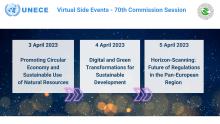
The 70th session of the United Nations Economic Commission for Europe (UNECE) will take place in April 2023 in Geneva. The Commission, UNECE's highest decision-making body, will take stock of its work to promote a circular economy and the sustainable use of natural resources.
Various virtual side events on 3-5 April will look at specific aspects of the circular economy transition, including the role of policies and institutions, innovation and private sector engagement, value chains, digital solutions and networks.
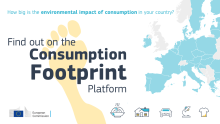
The European Commission organizes a webinar on 23 February, from 14:00 to 15:15 CET, to present the Consumption Footprint, a life cycle assessment-based indicator that quantifies the environmental impact of the consumption of the EU and EU countries.
The framework for inclusive circular trade is designed to help guide trade and trade-related circular economy and development policies, practices and agreements to ensure these all work towards a shared goal of an inclusive circular economy.
This paper sets out a framework for inclusive circular trade, intended to enable a pathway in which circular trade helps to promote fair, inclusive and circular societies. The framework was developed through the work of an alliance of organizations spanning Africa, Southeast Asia, Latin America and the Caribbean, and Europe.
Chatham House does not express opinions of its own. The opinions expressed in this publication are the responsibility of the authors. A Spanish translation of the paper is also available as a PDF.
NP-bioTech uses a biocatalyst, adsorbed onto an inert material (catalytic substrate). This enables the accelerated fermentation of critical biomass (such as citrus pulp or sewage sludge), transforming it into a biostabilised and pasteurised material with excellent agronomic properties.
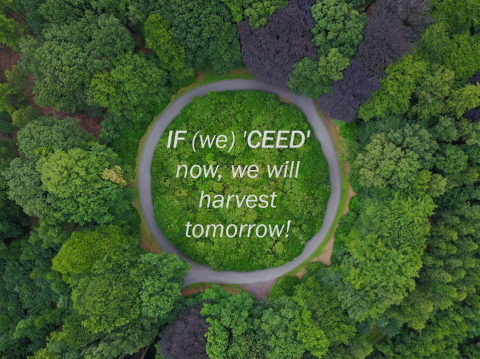
The Incubation Forum for Circular Economy in European Defence aims to apply the circularity approach of the EU Green Deal to European defence.
It does this by engaging a cooperative community, including EU defence ministries, industry, institutes, research centres, financial institutions, academia and other bodies at national and international level.
Working groups called "Project Circles" cover the following themes:
Critical Raw Materials
Circular Additive Manufacturing
Circular Materials for Textiles
Sustainable Ecodesign
EMAS Uptake Strategy
Green Procurement
Circular Data
Spare Parts Management.
Based on circular economy principles, IF CEED aims to incubate collaborative projects and their respective consortia.
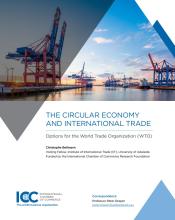
This study highlights that, while international trade has a vital role to play, policy responses to-date have largely been designed at the national level and in an uncoordinated manner.
ICC Secretary General John W.H. Denton says that "the report shines a light on how well-intentioned national policies are inadvertently hindering the adoption of circular solutions in the real-economy. Simply put: the transition to a circular economy can only be enabled at scale by harnessing the power of cross-border trade to unlock economies of scale and comparative advantages. We hope our analysis will serve as a clarion call for a concerted global effort under the auspices of the World Trade Organization to enable new patterns of trade capable of meeting global climate and sustainability goals".
Given the need totake biodiversity more into account in circular economy projects, this study aims to stress the links between the two and to clarify the role played by the circular economy in preserving ecosystems.
Several guiding circular economy principles contribute to reducing the impacts of our activities on ecosystems, such as non-toxicity, optimisation of resource management, promotion of renewable resources and looping of flows. The study also highlights the fact that each lever for implementing the circular economy can and should factor in biodiversity: land-use planning, normative framework, innovation, awareness raising and training, and economic support.