CircularPSP invites all parties interested in the public call for tenders for AI / platform / change-solutions for the circular economy transition in cities to learn more about it at a webinar on 11 January at 11:00 - 13:00 CET.
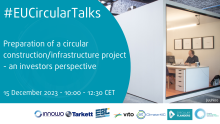
This EUCircularTalks event on “Preparation of a circular construction/infrastructure project - an investors' perspective" took place on 15 December at 10:00 - 12:30 CET. Various aspects of circular construction and infrastructure projects were explored.
The 4th International Conference on Strategies toward Green Deal Implementation – Water, Raw Materials & Energy (ICGreenDeal2023) will take place on 14-15 December. It will tackle climate change and ways to prevent it, including innovative solutions (technological, environmental, economic and social) that can be implemented under the Green Deal Strategies.
CEN and CENELEC, together with the European Commission’s Joint Research Centre (JRC), are carrying out an annual ‘foresight on standardisation’ initiative named Putting Science into Standards (PSIS).
The 2023 PSIS workshop on 12-13 December will focus on Circular technologies for construction. This workshop will bring stakeholders from the research, scientific and standardisation communities together with policy makers to debate standardisation needs for implementing circular technologies in the construction sector.
The European Commission invites people working in the built environment sector to join an online conference to take place on 13 December exploring Level(s), the EU common language for assessing and measuring the sustainability performance of buildings.
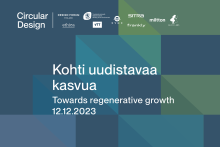
The one year long national Circular Design pilot programme is coming to an end! What did the companies get out of the programme? What did they achieve?
The results of the programme will be shared on 12 December in a hybrid event at 13:00 - 15:00 EET (12:00 - 14:00 CET), which is a World Circular Economy Forum side event.
The circular economy offers solutions to climate change and biodiversity loss at source. It's time to mobilise financing to accelerate the circular economy.
While sustainable tools like green bonds and impact investing can support circularity, unlocking the circular economy's financing potential is a challenge. Cooperation between the circular community, policymakers and financial institutions is vital for progress in financing the circular transition, especially as this is still seen as potentially risky.
This was the subject of a COP28 side event on "Accelerating the financing of the circular economy in climate and biodiversity strategies".
The event aimed to:
- analyse the current challenges in scaling up circular financing,
- facilitate the dialogue between key financial actors from the public and private sectors, standardisation bodies, policymakers and circular civil society actors,
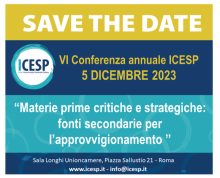
ENEA is organizing the 6th annual conference of the Italian Platform of Stakeholders for the Circular Economy (ICESP) in Rome and online on 5 December 2023 (9:30-16:15 CET). It will serve as a forum for extensive discussions among various stakeholders, including institutional and entrepreneurial entities, to explore ongoing initiatives concerning the procurement of secondary sources for critical and strategic raw materials.
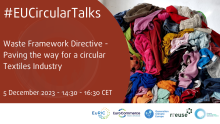
New waste management policies will change the way the EU handles textiles waste. The proposal for a new Waste Framework Directive aims to accelerate the development of the separate collection, sorting, reuse and recycling of textiles, in line with the EU Strategy for Sustainable and Circular Textile and the Circular Economy Action Plan.
On 5 December 2023 at 14:30 - 16:30 a discussion between stakeholders in the value chain will focus on how the sector sees the implementation of the Waste Framework Directive and the Extended Producer Responsibility for textiles in practice.
EDANA, the leading global association and voice of the nonwovens and related industries is launching its first Sustainability Forum, which is an evolution of their previous Circular Nonwovens Forum. It will cover all relevant sustainability topics for the nonwoven industry: natural raw materials, consumer expectations, circularity, bio-economy, etc.