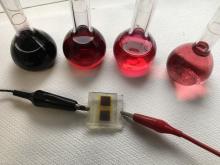
Giving value to waste as a precious renewable resource: for the first time, agri-food waste can be exploited to create photovoltaic cells that produce sustainable electricity. From the residues derived from winemaking (normally disposed of without any other use), researchers can extract natural dyes that capture solar energy, transforming them into a regenerated green resource.
The University of Malta has developed a patented process that recycles limestone and concrete construction and demolition waste into masonry products. These have superior mechanical properties compared to natural limestone products.
The Dublin City University VALOR project is investigating potential recovery options for the Organic Fraction of the Municipal Solid Waste (OFMSW) and Bio-Stabilised residual waste (BSRW). The project fully diagnoses the recovery options for municipal solid waste and validates their use by determining their benefits and potential environmental risks.
The Caverne d'Ali Baba (Ali Baba thieve's cave) is an initiative by and for students in the art school of ESA Saint-Luc, in Brussels.
According to the Fédération des Récupérathèques, of which the initiative belongs to, the service stands as a shared and co-managed warehouse of reuse materials, available to students for any of their creative projects.
In circular economy secondary resources (i.e. end-of-life products), the industrial side streams and wastes, are the “wasted resources of today”, if they are not utilized and returned for use.