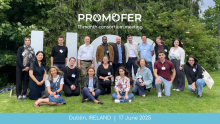
The PROMOFER project aims to use low value feedstock (straw, industrial wastewater and starch, mostly) to manufacture valuable biobased compounds. Specifically, it will improve the fermentation processes and downstream purification, solve bottlenecks upstream and downstream, and produce high-value applications.
The annual Circular Economy Insights Series helps shape strategies and informs the development of support for communities of practice across Ireland. It highlights research gaps and will guide work in this area.
The 2025 report is designed to support an evidenced-based approach to public engagement and communications for a circular economy. It integrates best practices, targeted market research, socio-demographic analyses and community initiatives to provide key insights and statistical evidence on the specific trends currently driving circular economy behaviour in Ireland.
It aims to strengthen capacity for high-quality communications and public engagement to ensure that Ireland is informed and enabled to participate in, and benefit from, the circular transition.
The WEEE Forum aimed to formulate recommendations on potential future targets for WEEE collection and on the method for calculating the collection rate which would foster the circular economy.
This study accordingly conducted a comprehensive assessment of current WEEE collection rate calculation methodologies and proposes a new approach for setting WEEE collection targets in the EU. It took a multi-phase approach, including data collection, model development and sensitivity analysis. Interviews with experts and stakeholders were also carried out to validate assumptions and explore new target-setting approaches.
The study concludes that the WEEE generated method is preferable to the current POM (put on the market)-based collection target.
Mexico Circular Hotspot will take place on 5-6 November. It will focus on bringing together stakeholders from business, governments and knowledge institutions to advance the circular economy in Mexico and the Americas.
This two-day event of intense cross-border and cross-sectoral pitching, matchmaking and networking aims to link industry to innovative (biobased) technologies, and innovators to investors.
This online workshop will mark the official launch of the final version of the Self-Assessment Tool, a key component of the CCRI designed to support cities, regions and territorial clusters in monitoring circular activities.
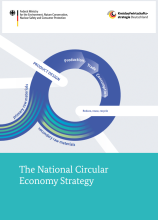
Germany's National Circular Economy Strategy adopts a strategic vision focused on reducing the consumption of primary raw materials. This approach is guided by the proposal from the International Resource Panel, under the United Nations Environment Programme (UNEP), which sets a global target of 6-8 tonnes of raw material consumption per capita per year by 2050.
The strategy considers every stage of the cycle: product design, material selection, production, maximising the use phase and, finally, reuse and recycling. It aims to prevent waste from being created in the first place. This can be achieved through smart product design, efficient manufacturing, extended product lifespans, easier repairability and maximising the recycling of all materials.
The MANTRA project, funded by the EU under Horizon Europe, aims to accelerate the green and digital transformation of manufacturing SMEs in Europe by promoting advanced technologies and social innovation.
They have three open calls: for Manufacturing SMEs, Tech-savy SMEs and External Evaluators.
Taranto CirTech has launched the Call4Ideas. It invites startups, innovative projects, young companies and emerging organisations to apply to join an acceleration programme designed to transform high-impact ideas into tangible, sustainable and scalable solutions. Apply by 22 June!
This workshop will discuss the future of the DECISO pilot projects, diving into the business models that have been built around them, and explore pathways for scaling up successful circular economy solutions in similar contexts.